Photo courtesy Jonathan Maus |
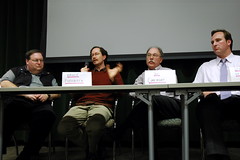
Photo courtesy Jonathan Maus |
Update: An audio clip (QuickTime player required) is now available at NW Progressive Institute.
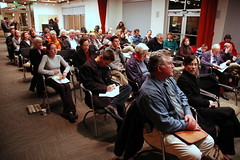
I had an enjoyable time at CLF’s Columbia River Crossing forum last night. The crowd was lively, and generally skeptical.
A theme emerged, which is that many folks, including some elected officials and task force members (and yours truly) are very uncomfortable that the recommendation is to take only two real options into the DEIS (there are flavors, but they don’t amount to much difference): a very expensive bridge or a no-build. A lot of us would feel better if there were low- and/or mid-priced options going into the analysis, so that we can have some real cost/benefit trade-offs to look at when the DEIS is completed.
The question now is whether the task force, or one of the local governments that have to sign off the decision, will express the same concern?
99 responses to “Report from the CLF CRC Forum”
very uncomfortable that the recommendation is to take only two real options…a very expensive bridge or a no-build
Sorta sounds like the approach of the “alternatives” analysis for the east side street car?
Touche :-)
a very expensive bridge or a no-build.
Its not really “no-build” – its “no action” at all and doesn’t meet the purpose and need of the project. As the staff report makes clear, it is only there because it is legally required in order to provide a point of comparison.
In fact, accepting the staff report is approving a new replacement bridge as the only real option. The only remaining question is whether the transit component will be light rail or bus rapid transit. And of course the details of the bridge design and financing schemes.
They have removed any consideration of non-engineering solutions like congestion pricing or land use regulation. Just as they have eliminated relieving the pressure on I5 by creating a local street connection across the river for the local traffic that makes up over a third of the trips across the river.
Ever since the arterial with MAX option was kicked out of the Governors’ I-5 Task Force recommendations on a 10-10 tie vote, this whole thing has been rigged to get to where it is…a big, expensive, new bridge.
But in addition to the arterial option, the DEIS should analyze tolling plus aggressive transportation demand mangement. Both of these will be required to make the big new bridge work…financially and operationally. Why not try it before we spend $2Billion? We had a grand experiment in TDM in ’97, and the bridge congestion went away.
As Joe Cortright pointed out, congestion indicates excessive demand for limited supply; raising the price above “free” will reduce demand and save the region a lot of money.
Last thought…one of my vanpool members from Battle Ground solved the problem of the cross river commute her own way…she moved to N. Portland. UPS did a similar thing…it solved the crossing problem by building a local hub in Vancouver and moving 100 jobs there.
I wish I could have been there but other obligation prevented me from having that option.
However, as Chris and others have pointed out that heading into this DEIS phase with in effect only two options, is not right!
As Lenny pointed out that the Governor’s I-5 Bi-State Transportation and Trade Partnership Study Group arrived at point to where a 10 – 10 vote was taken and political and special interests grabbed control and have spun this CRC Project into a statement of having a mandate that the only solution is replacing the Interstate Bridges.
I had a very high ranking person in this CRC Project tell me that it was to all effect dead and that they could only get it back on track was by adding in the High Capacity Transit option on the same bridge structure and what he was talking about was MAX Light Rail to keep it alive.
There are other ways, other options to get MAX Light Rail into Vancouver that are much more likely to succeed politically and are much less costly but to consider any of these options could kill this CRC Interstate Bridge Replacement Project. That is why there are no other options on the table.
Hello people!!
What do you think the last 8 years have been about? Real people have studied and studied the problem of the bridge and finally, finally, finally concluded that the following ideas DO NOT work in a meaningful way to solve congestion, improve safety and ease freight movement:
TDM
A third bridge
The do nothing option
tolling (by itself)
land use changes (by itself)
Do you really think there is some massive conspiracy perpetuated by the auto and oil firms, in cahoots with the local, regional and state governments to waste taxpayer money on study after study in order to justify a foregone conclusion? Doing so is truly an insult to all the dedicated, hardworking members of the various teams that have worked their bums off to develop solutions faced by thousands of people everyday.
Have you ever considered that the solution may be the simplest idea of them all: To just replace a small, old and unsafe structure with a larger, newer and safe structure that combines infrastructure improvements for ALL modes of transportation? Yes, Virginia, it really can be that simple.
Only 2 ideas are being moved toward an EIS. Don’t forget that literally HUNDREDS of other options have already fallen by the wayside. They were rejected for reasons you think you might know, but if you consider it for a second, you probably know little or nothing about: the Oregon and Washington highway design standards, the Highway Capacity Manual, Coast Guard regulations, seismic engineering, vehicle crash analyses, transportation funding problems, computer modeling simulations and other travel demand tools, the myriad environmental, archeological and wildlife regulations in effect and exactly how the entire process comes together.
Oh, and balancing the needs of all diverse groups who use the bridge:
Hummer-driving, rural-living Republicans
LRT-riding, urban-living Democrats
Business owners
Consumers
Seniors
Students
Soccer moms
6-pack dads
etc
And then, on top of everything – please, please, please don’t forget that everything, everything, everything needs to be seen through the political lens: neighborhood politics, local politics, regional politics, city politics, state politics, federal politics and every other politics you can think of.
We are so lucky to live in this area and have so many people interested in transportation and in improving their communities. This has been an incredible asset to making and sustaining the livability of the Northwest. And the second-guessing will never stop – nor should it.
But ya’ll have to be kidding me if you don’t think that:
a) This process has probably been the most transparent and detailed analysis for this type of project ever – and anywhere
b) The solutions currently proposed after years of study have only been arrived at after a strict process that has vetted out much poorer ideas
and
c) The people involved in making those decisions, to a person, have the public’s BEST INTEREST as heart, and at all times.
Thank you
I’ve got a huge problem with $2 billion new bridge or “status quo” as the only options. As Chris noted, the DEIS should include some low-cost and mid-cost options.
Why not develop a low cost “engineering fix plus tolls and demand management” option? Three lanes freeway traffic each way, with peak demand managed by congestion tolls.
Of particular interest to me was the revelation that we can solve the river traffic issue with a $40 million fix to the railroad bridge — install a lift span that lines up with the “hump” and barge traffic no longer needs to use the lift span.
How much would it cost to raise the existing bridge ten feet to provide additional clearance under the hump? Would the cost be significantly less than $2 billion? Would it eliminate enough bridge lifts to dramatically reduce the rate of accidents?
Add a parallel light rail bridge with two traffic lanes for local traffic, plus wide bike lanes, and you have very nearly the same transit benefit for what is undoubtedly a significantly lower cost.
If we spend “only” $1 billion on the bridge, we could invest the other $1 billion at 5%. That’s $50 million per year, or almost $200,000 per non-holiday weekday. How many peak-hour express buses and commuter trains would that pay for?
If the task force goes forward with ONE option, I can see a successful court challenge to the EIS for failure to consider, let alone sufficiently evaluate, other options.
i do agree that these alternatives are the only ones proposed to move forward because they are the only ones that ‘fix’ the problems. but i think the DEIS needs to include a mid-level option even if it is actually not feasibly going to be built because it will demonstrate to the public WHY it doesn’t work or make sense.
the analysis in the DEIS will likely show that a mid-level option is cheaper but does not solve the congestion and shorten the rush hour enough. or it will show some mid-level improvement over no-build just as it is a mid-level fix. at least then the information is there and the public can see and use the information to compare to the big new bridge options.
Do you really think there is some massive conspiracy
No. But there is little doubt that the staff at WashDOT concluded there was a need for a replacement bridge before this process started and it has been managed to bring the decision makers to the same conclusion. They didn’t dump 7 freeway lanes onto the existing But ya’ll have to be kidding me if you don’t think that:
Actually I think you are wrong on parts one and two. As for number three, who are you trying to kid? Of course they have the public’s interest at heart, but the decision makers are all adults with institutional interests of their own. They want a solution that both serves the public AND their institution.
Moreover, as a practical matter, they want a project that will win political support in congress from both states congressional delegations. On top of that list is Washington Senator Patty Murray, who has seniority on a key committee. Without her enthusiastic support there will be no $2 billion bridge. And Patty Murray doesn’t represent North and Northeast Portland. She does represent Clark County.
What do you think the last 8 years have been about?
Getting the politicians on the Oregon side of the river to accept a new auto-centric bridge.
TDM
A third bridge
The do nothing option
tolling (by itself)
land use changes (by itself)
But in fact, none of those options have been studied. They have simply been rejected – in fact Henry Hewitt started the task force with the statement “We all agree that doing nothing is not an option.” You could say the other three alternatives had about as much consideration given to them.
A simple question. What level of tolling of the current bridges would reduce the traffic congestion to acceptable levels? The answer is not to be found anywhere in the reports or studies.
What will happen to the ramp meters in North and Northeast Portland? ODOT initially claimed widening the bridge would reduce waiting times and then retracted that claim when asked for some evidence to support it by members of the task force. They then refused to provide the task force with an analysis of that question. Nonetheless, they included the claim in their open house information after the task force met.
In short – there is plenty of evidence that the process of the I5 task force has been managed to achieve a specific outcome. Using that process to validate the results is bogus. Whatever the task force comes up with needs to be defensible on its own, not because the process that produced it was a comprehensive evaluation of all the alternatives. It wasn’t.
The reality is that if the only choices are as they stand, the no-action option is preferable. Unfortunately that means any relief that might have occurred from more realistic proposals will be delayed another ten years.
I’ve got a huge problem with $2 billion new bridge or “status quo” as the only options. As Chris noted, the DEIS should include some low-cost and mid-cost options.
*** Sorry, but those ‘low-cost’ and ‘mid-cost’ options have been already thoroughly studied – and they don’t solve the problem.
Why not develop a low cost “engineering fix plus tolls and demand management” option? Three lanes freeway traffic each way, with peak demand managed by congestion tolls.
*** Because 7 years if work show they this will not work
Of particular interest to me was the revelation that we can solve the river traffic issue with a $40 million fix to the railroad bridge — install a lift span that lines up with the “hump” and barge traffic no longer needs to use the lift span.
*** Fixing 2% of the total problem is not a solution. And since when does public transportation money get spent on private railroads? (BTW – ask the RR’s if they get $$$ from the public – they don’t)
How much would it cost to raise the existing bridge ten feet to provide additional clearance under the hump? Would the cost be significantly less than $2 billion? Would it eliminate enough bridge lifts to dramatically reduce the rate of accidents?
*** This has been looked at repeatedly and a) does not solve the problem (see comment above) and b) is very expensive
Add a parallel light rail bridge with two traffic lanes for local traffic, plus wide bike lanes, and you have very nearly the same transit benefit for what is undoubtedly a significantly lower cost.
*** See previous comments
If we spend “only” $1 billion on the bridge, we could invest the other $1 billion at 5%. That’s $50 million per year, or almost $200,000 per non-holiday weekday. How many peak-hour express buses and commuter trains would that pay for?
*** Unfortunately, transportation funding does not work like this
If the task force goes forward with ONE option, I can see a successful court challenge to the EIS for failure to consider, let alone sufficiently evaluate, other options.
*** Trust me when I say that there will not be a successful court challenge (if there is one at all) because all of the many years of previous work has more than sufficiently proven that a) hundreds of other options have been considered and b) the ones moving to the EIS are the best of the bunch.
For Jessica:
Those mid-level options have already been tested over and over again – they don’t work. This information is already available to public and has been made so again and again. Have you attended any of the Task Force meetings?
I’m really not making this stuff up. I am telling you the truth. I know it may be difficult to understand the process but it doesn’t change the facts of the case. This project is super-detailed and ultra-sensitive to new and different ideas and they have been considered. There is a reason we have engineering standards and that is to build the best, most cost-effective, safe solution. Really – no bull.
think the DEIS needs to include a mid-level option even if it is actually not feasibly going to be built because it will demonstrate to the public WHY it doesn’t work or make sense.
My concern here is that the “mid-level option” might be designed to fail. The DEIS should include several “low-price” and “mid-price” options designed by bona fide proponents of those options (CLF or AORTA, for example), rather than staff looking for a reason to reject them and push the pre-determined conclusion.
Ross:
If WSDOT concluded that a replacement bridge is necssary, it was only through previous studies and the judgment of engineers with hundreds of years of experience between them. It was hardly a foregone conclusion.
Re: ODOT/WSDOT wanting a high budget project. Sorry, but that isn’t how those institutions work. With billions of dollars of projects not getting built, why would those groups want to spend there funds all in 1 place?
I know you may think I’m worng on my pts 1 & 2 and you are entitled to your opinion. But if you ask real transportation professionals they will tell you that those points are true. I’m not making them up.
As I said, politically wills are just as important as engineering considerations. Don’t you want federal $$$ spent in our states? If you don’t – we would never have gotten any $$$ for light rail – or anyplace else for that matter. The FTA process for light rail works very similar to FHWA’s…
Trust me – look up any all all ODOT/WSDOT documentation. Everyone of the options I listed have been studied. And studied. The do-nothing option is part of every EIS.
Your point about tolling is a good one. And I actually think it would be interesting. But like I said, it is basically a political nonr-starter – 95% of the public would not want it and it still doesn’t solve several other problems – such as safety, river traffic concerns, or existing sub-standard engineering, for example.
Actually, all the ‘evidence’ you point is not really evidence as it is a lack of understanding on your part regarding the highly intricate and complex process that today’s transportation projects require. Sorry to be so blunt but you don’t have 35 years of transportation project mgmt experience do you? How would you know anything about the process? I read the newspaper and blogs and this site (great site Chris) too. And you may onyl get 1% of all the info out there. Hardly enough to make informed decisions on processes that have taken 50 years to develop.
Mr. Tired may or may not have been part of this I-5 process that has most recently got us to a point where we have the current CRC Project recommendations. Your humor is nice and funny and we all share in our admiration of all of those who contribute to the public process.
But an isolated targeted CRC Project that just replaces the Interstate Bridges which may only correct 5% of the problems of the I-5 corridor through Portland is streaching your credibility as the singular project that solves all of the problems. MAX/HCLRT is projected to reduce or eliminate another 2% of the vehciles in the I-5 Corridor, but I agree we need it. We have to look to the future and HCLRT will reduce the upward curve of congestion and vehicles in the I-5 corridor.
There is nothing wrong physically with the current I-5 Interstate Bridges. They are 3-lanes and effectively meter traffic to the capacity of all of the existing interconnecting interstate highways networked in Portland/Vancouver. To introduce and induce more traffic and vehicles with a 6-lane bridge destroys balance.
85%+ of the 65,000 commuters in the AM and PM rush hours travel past the Interstate Bridge project areas in the I-5 corridor and this CRC project will not solve their problems, it will just make them worse for the majority and more costly.
This CRC Project does not solve the environmental catastrophe or the complete lack freight mobility we currently have and experience in the I-5 corridor, it perpetuates it.
There are solutions and alternatives and I hope Chris posts some of them and they do not require the Interstate Bridges to be replaced, that will result in the real possiblity of tolls getting placed on the I-5 and I-205 corridors.
but to cast these current efforts as anything but special interest solutions but it would be nice
With billions of dollars of projects not getting built, why would those groups want to spend there funds all in 1 place?
This project will only be funded by an earmark at the federal level. The money would not get spent elsewhere. And from Oregon’s perspective, Patty Murray is much more likely to go after money for Seattle area projects than alternative projects in Oregon if she isn’t committed to a $2 billion interstate bridge.
But if you ask real transportation professionals they will tell you that those points are true. I’m not making them up.
Here are the two points:
“a) This process has probably been the most transparent and detailed analysis for this type of project ever – and anywhere
b) The solutions currently proposed after years of study have only been arrived at after a strict process that has vetted out much poorer ideas”
What exactly makes “real transportation professionals” experts on public process? These are barely disguised self-congratulatory expressions of opinion that don’t stand up to any serious evaluation.
Don’t you want federal $$$ spent in our states?
No, I don’t. Not if the way they are spent damages the quality of life.
But I think there are many people who are part of this process who do agree with you. If the choice is between a $2 billion bridge and a better, but less expensive, solution that doesn’t bring in federal dollars, they will take the $2 billion bridge and the federal bucks.
Everyone of the options I listed have been studied.
As I stated, they haven’t. There has been no study done of the impact of tolls or congestion pricing within the I5 process. There has been no study of land use changes. There has been no study of the impact of a widened bridge on access to the freeway from North and Northeast Portland. There has been no evaluation of the what maximum impact can be obtained from TDM.
It was hardly a foregone conclusion.
No one said this was a foregone conclusion, that’s why it has taken three studies and millions of dollars to get to this point. The question is whether the process was designed to bring people to a specific conclusion, not whether it was inevitable that it would succeed. The first two studies didn’t which is why they were steered away from making specific recommendations.
Trust me
Why?
you don’t have 35 years of transportation project mgmt experience do you?
No. I have 35 years of experience working with public involvement processes. And when someone says of a public decision involving billions of tax dollars that “its too complicated to explain, trust me” …
But of course, that is where this started. The fact is that the folks who ran this process agree with you. They think the decision is far too complicated for a group of citizens and politicians to make. So they made the decision and developed a process to get it accepted.
Mr. Tired may or may not have been part of this I-5 process that has most recently got us to a point where we have the current CRC Project recommendations. Your humor is nice and funny and we all share in our admiration of all of those who contribute to the public process.
But an isolated targeted CRC Project that just replaces the Interstate Bridges which may only correct 5% of the problems of the I-5 corridor through Portland is streaching your credibility as the singular project that solves all of the problems. MAX/HCLRT is projected to reduce or eliminate another 2% of the vehciles in the I-5 Corridor, but I agree we need it. We have to look to the future and HCLRT will reduce the upward curve of congestion and vehicles in the I-5 corridor.
*** “may only correct 5% of the problems of the I-5 corridor”. Truly, can you actually put a number on this? No. Light rail will help reduce vehicles trips across the river today, and will help in the future, but people will continue to drive. I know it’s sad, and I really wish it wasn’t like that, but it is still true.
There is nothing wrong physically with the current I-5 Interstate Bridges. They are 3-lanes and effectively meter traffic to the capacity of all of the existing interconnecting interstate highways networked in Portland/Vancouver. To introduce and induce more traffic and vehicles with a 6-lane bridge destroys balance.
*** “There is nothing wrong physically with the current I-5 Interstate Bridges”. This is 100% falsehood. You don’t have to believe me when I tell you that, but they are seismically unsafe and completely substandard as freeway bridges. Don’t you think there is a reason they average over 1 crash per day? They do meter traffic, both directions – actually, you have contradicted your first point. If the bridges had nothing physically wrong with them then they would operate like regular travel lanes and not meter traffic.
85%+ of the 65,000 commuters in the AM and PM rush hours travel past the Interstate Bridge project areas in the I-5 corridor and this CRC project will not solve their problems, it will just make them worse for the majority and more costly.
*** I assume you have gotten your figures from the travel demand modeling software (costing in excess of 10K) that you run on your home computer in combination with your 15+ years as a travel modeling expert? No? Where are you getting your data from then?
This CRC Project does not solve the environmental catastrophe or the complete lack freight mobility we currently have and experience in the I-5 corridor, it perpetuates it.
*** Why don’t you tell me why it doesn’t? Again, using your expertise as a freight planner or environmental engineer…
There are solutions and alternatives and I hope Chris posts some of them and they do not require the Interstate Bridges to be replaced, that will result in the real possiblity of tolls getting placed on the I-5 and I-205 corridors.
but to cast these current efforts as anything but special interest solutions but it would be nice
*** If by special interest you mean the general public and the states of Oregon and Washington I agree with you.
With billions of dollars of projects not getting built, why would those groups want to spend there funds all in 1 place?
This project will only be funded by an earmark at the federal level. The money would not get spent elsewhere. And from Oregon’s perspective, Patty Murray is much more likely to go after money for Seattle area projects than alternative projects in Oregon if she isn’t committed to a $2 billion interstate bridge.
*** The bridge will be tolled. Tolls will pay for the bridge. Just like the 2 pervious times the bridge has been built
But if you ask real transportation professionals they will tell you that those points are true. I’m not making them up.
Here are the two points:
“a) This process has probably been the most transparent and detailed analysis for this type of project ever – and anywhere
b) The solutions currently proposed after years of study have only been arrived at after a strict process that has vetted out much poorer ideas”
What exactly makes “real transportation professionals” experts on public process? These are barely disguised self-congratulatory expressions of opinion that don’t stand up to any serious evaluation.
*** Real transportation professionals deal with the ‘public process’ every day of their careers. The real transportation professionals are the heads of projects are experts in public process. They didn’t get to those positions because they have great teeth.
Don’t you want federal $$$ spent in our states?
No, I don’t. Not if the way they are spent damages the quality of life.
*** Driving does damage some people quality of life. But then again, the vast majority of people consider driving in uncongested conditions resulting in more time with family as an improvement in the quality of life.
But I think there are many people who are part of this process who do agree with you. If the choice is between a $2 billion bridge and a better, but less expensive, solution that doesn’t bring in federal dollars, they will take the $2 billion bridge and the federal bucks.
*** Doesn’t work like that.
Everyone of the options I listed have been studied.
As I stated, they haven’t. There has been no study done of the impact of tolls or congestion pricing within the I5 process. There has been no study of land use changes. There has been no study of the impact of a widened bridge on access to the freeway from North and Northeast Portland. There has been no evaluation of the what maximum impact can be obtained from TDM.
*** You are wrong. They have been. Look at the thousands of pages of documentation on this project.
It was hardly a foregone conclusion.
No one said this was a foregone conclusion, that’s why it has taken three studies and millions of dollars to get to this point. The question is whether the process was designed to bring people to a specific conclusion, not whether it was inevitable that it would succeed. The first two studies didn’t which is why they were steered away from making specific recommendations.
*** Almost every post on this forum re: the CRC project has tried to make the point that the replacement option had already been decided upon before the project started and the project was just to ‘confirm’ the foregone conclusion.
Trust me
Why?
*** I have no reason to lie to you – I don’t even know you. I want the best, most efficient project too.
you don’t have 35 years of transportation project mgmt experience do you?
No. I have 35 years of experience working with public involvement processes. And when someone says of a public decision involving billions of tax dollars that “its too complicated to explain, trust me” …
*** Well it is hard to explain thousands of pages of standards, rules and reg in a blog…and since I’m guessing that you know less about this stuff than I do…let’s just say it’s complicated and if you want, all the docs are out there…
But of course, that is where this started. The fact is that the folks who ran this process agree with you. They think the decision is far too complicated for a group of citizens and politicians to make. So they made the decision and developed a process to get it accepted.
You know what? It actually is too complicated of a decision for citizens and politicians to make. It really is. That’s why states hire professional, licensed experts to do the work. Every single time.
One thing admitted to at the meeting last night was the 2 billion dollar price tag for a big new bridge is just a premature guesstimate. (Remember Sam’s TRAM), No accurate cost projections exist. I agree with those whom view this whole Columbia Crossing exercise as an expensive charade and window dressing to support a preconceived plan to build a big new bridge, and also to make to sure light rail crosses the river preferably also on a new bridge. I also agree with the concept of moving forward a projected less costly middle ground option that would include making use of the existing bridges. In doing so, a comparison of value for the dollars spent can actually be debated. I also believe the study of a second option other than no build is a requirement to receive federal funding.
Any comparison of costs also must break down the costs per option for each mode of travel. As an example: the big new bridge proposal has 3 through motor vehicle travel lanes in each direction, and at least 2 additional lanes in each direction for local traffic, probably an approximate width of a lane in each direction for shoulders, totaling 12 lane widths for motor vehicles and freight carriers. Add to 2 lane widths for transit and one lane width for bicycles and pedestrians making the total bridge approximately 15 lane widths wide.
Apportioning the support and superstructure per lane, a simple breakout to calculate what each mode costs would be to divide the total cost by 15 – multiplied by 12 for motor vehicles and freight carriers, multiplied by 2 for transit, and multiplied by one for bicyclists and pedestrians.
The next calculation would be to take the costs of construction per mode, and divide by the number of users for each mode thereby deriving the cost of construction per user of each mode.
Another factor that could be added in that would raise the proportionality price tag for transit would be the extra costs of electrification for light rail. Under maintenance and operation costs, the non-user 80% taxpayer subsidy to transit also must be weighed against any bridge operation and maintenance costs for other modes.
Any tolling that takes place for bridge users to cross the river must be for all users, must reflected by mode specific costs, and must be mode specific for each mode to pay for the construction costs of that specific mode. In other words, “IF” tolls become part of the financing scheme, all bridge users including transit riders, bicyclists and pedestrians must pay a toll with the dollars collected going only to pay for the construction costs for infrastructure of the mode being used. Charging any tolls must mean no free rides across the bridge, what ever the mode – It is a matter of fairness in that all users receive a benefit. .
Furthermore, calculating the cost for each mode to cross the river would also justify or not justify if for example, should exclusive infrastructure for bicycles and pedestrians even be included on any new bridge? If the user demand does not exist (no politically motivated hyped projections allowed), it might be more cost effective to require bicyclists and pedestrians to use the transit option to cross the river – and by receiving benefit from the crossing, like other transit users, pay the both the transit fare and the surcharge or toll collected that must be collected by transit riders to help pay for the bridge. Just because a policy exists to include bicycle and pedestrian infrastructure as part of the project, if a real demand does not exist demonstrating there is little value with an enormous price tag, taxpayers must not be scammed into paying for such an option. Such a policy must then be changed!
Looking aroung the US, is “35 years of transportation project mgmt” really a positive? Our country is a mess, the “experts” have forced us into a single mode of transportation with no solution in site. This “solution” is nothing but a retread of tired old practices that have proven to do nothing but cause more transportation problems.
Don’t you think there is a reason they average over 1 crash per day?
One reason is that WashDOT took one of the bridge lanes to use to merge traffic from SR14 instead of creating a connection upstream from the bridge with adequate approaches. Another reason is that they are unwilling to slow traffic on the bridge.
If the bridges had nothing physically wrong with them then they would operate like regular travel lanes and not meter traffic.
That simply isn’t true. The metering is a capacity issue. The new bridges will meter the traffic as well, they will just turn the meter up a notch and flood North and Northeast Portland with more traffic.
No. Light rail will help reduce vehicles trips across the river today, and will help in the future, but people will continue to drive.
No, light rail won’t reduce the number of trips across the river. It will just allow for more trips across the river despite the congestion on I5 and local Portland streets. Congestion which a new bridge will not reduce or eliminate.
You know what? It actually is too complicated of a decision for citizens and politicians to make.
And, I would assume, the “professional transportation planners” you talk with agree with you. Including those managing the various “studies”.
But the the real experts are the citizens who have to live with the results. The impacts on the community are far too complicated for traffic engineers to be able to make the decision. Especially when their professional career choice was training to engineer large transportation projects. A guy whose only tool is a hammer thinks everything looks like a nail.
Just because you have a driver’s license does not make you a traffic engineer. Far from it in fact but one of the unfortunate parts of this biz is that everyone not in thinks they are an ‘expert’. Which is not true.
Of course “The metering is a capacity issue”. But is is the capacity of the bridge we are talking about. 11 foot lanes do not carry as much traffic as 12 foot lanes (the standard). Thus, a bridge with 3 11-foot lanes, “meters” traffic originating from an area of 12-foot lanes (vancouver). Why do you think vehicles speed up leaving the birdge northbound, This is in the HCM. Look it up, I think you can find it online. Based on 50+ years of field studies done by folks with PhD’s.
Light rail will be built. You can take that to the bank.
The bridge will be tolled. Tolls will pay for the bridge. Just like the 2 pervious times the bridge has been built
It is highly doubtful tolls will pay for the bridge. But if you are correct the money will come from tolls, why did you ask this:
“With billions of dollars of projects not getting built, why would those groups want to spend there funds all in 1 place?”
The answer either way is that they wouldn’t get any money if they didn’t build the bridge. A toll that paid for transit alternatives for the people who couldn’t afford to pay it is not going to pay for any of those “billions of dollars of projects” either.
I have no reason to lie to you
I thought you meant trust your judgments, not whether you believed them. You seem to be in love with traffic engineers and believe them to be infallible.
Real transportation professionals deal with the ‘public process’ every day of their careers.
So do politicians. It doesn’t make their judgments of their own process objective.
Well it is hard to explain thousands of pages of standards, rules and reg in a blog…and since I’m guessing that you know less about this stuff than I do…let’s just say it’s complicated and if you want, all the docs are out there…
I don’t know who you are, so I have no way of knowing. I am certainly not a traffic engineer. But I attended almost every one of the Partnership meetings and participated in all their public process. So if you know more about what actually happened with that process than I do, I would be surprised. I have not been involved with the most recent round of discussions. But its pretty clear things are working pretty much the same.
As for the docs, they are out there. And several things you have claimed were studied, never were. I suspect you are taking the “professionals” you talk with on faith.
So where is that study of the likely impact on ramp meters in North and Northeast Portland? Isn’t it a pretty serious consideration if you are improving access to Portland jobs from Clark County exurbs while reducing access to area employment for people who live in North and Northeast Portland. Isn’t that the pattern for what has happened to Detroit and a lot of other cities whose urban core has been hollowed out?
Light rail will be built. You can take that to the bank.
Dear Mr. Tired –
As accusations of a light-rail “cabal” abound in this forum (I have been accused multiple times of being a member of said “cabal”), can you shed some light on why Light Rail will be built? Why, then, is BRT still on the table if the decision for rail has already been made?
You seem tired of characterizations of the CRC task force as having a preselected conclusion, or a foregone conclusion to use your words. Yet, here you are, tossing out this little grenade of wisdom, that Light Rail will be built.
While I, for one, would love to see Light Rail extended to Vancouver and Clark County, I strongly desire that such a project be the result of a legitimate and informed public process.
– Bob R.
Even the advocates of this project will tell you that when it is finished congestion will be about what it is today, and that only aggressive transportation demand management (TDM) will keep things moving.
If the bridge is held to the I-5 TF recommendation of 10 lanes of which 6 are thru lanes, that is just two more thru lanes than we have today, and you can be sure that there will be no more talk of yet another bridge. Hence TDM will be necessary. So my question is…if this is so, then why not start the TDM today, including tolling, and save us all a couple of $ Billion.
We can’t build ourselves out of congestion, so why are we wasting so much money trying to do it in this case, especially when Portland’s reputation for “sustainability” has the rejection of that myth as one of its pillars.
I dare the CRC to have an independent analysis of TDM measures and the arterial bridge with MAX done…I have no confidence in ODOT/WashDPT staff on this….much like the LUTRAC option on the westside bypass done by 1000 Friends.
But is is the capacity of the bridge we are talking about. 11 foot lanes do not carry as much traffic as 12 foot lanes
That simply isn’t true.
Why do you think vehicles speed up leaving the birdge northbound
Because they slowed down to cross the bridge. But maximum capacity is somewhere between 35 and 40 mph. It has nothing to do with how wide the lanes are at those speeds.
Light rail will be built. You can take that to the bank.
Probably eventually. So the folks in North and Northeast Portland will have to stand all the way downtown because all the seats were taken at the Clark County park and rides. How does that benefit anyone in Portland? Clark County has no interest in helping Portland residents get to jobs in Clark County.
So the folks in North and Northeast Portland will have to stand all the way downtown because all the seats were taken at the Clark County park and rides.
There is a simple remedy for this, if it becomes a problem.
Currently, much of the Yellow Line capacity is handled by single-car trains. If the line is extended to Vancouver, two-car trains will become the standard.
For trains departing Vancouver (which will be starting their runs completely empty), the operator can open just the doors of the front car. The rear car can remain empty until the 1st Oregon stop. There will be more than enough capacity in one car for the first Vancouver stops, and this will leave seats available for those boarding on the Oregon side.
For evening outbound trains from Portland, this process does not need to be used, because Oregon and Washington riders will be boarding in mixed crowds.
– Bob R.
Bob –
I know there are solutions, the question is really whether Trimet and CTRAN are going to implement them. I think its going to be tough to tell people to stand up while a car remains empty. I know I wouldn’t be happy. My point is that it seems that light rail to Vancouver is often treated as a concession by folks in Washington to Portland’s obsession with transit. That Portland “gets” light rail and Clark County “gets” more freeway lanes.
In truth there are very few benefits for Portland in this whole process. There may be some improvement in freight access depending on how the designs work out. But Portland is mostly in a position of just trying to limit the damage. Even extending light rail to Vancouver is really a cost, not a benefit.
Since TriMet and politician transit advocates can not get their act together and charge fares that better reflect the financial costs of providing transit service; if Max crosses the Columbia, Washington taxpayers must be charged to pay the current 80% percent subsidy it costs to support the service.
Ross:
From your comments it is easy to see that you do not understand the very basics of traffic flow theory, which has (and is still being) developed over the past 50+ years. Take a look at something called the Fundamental Diagram, which explains the relationship between speed, volume and vehicular density. An examination of the Highway Capacity Manual, attendance at the annual Transportation Research Board conference or even some classes at Portland State will enable you to acquaint yourself with this deeply detailed and wholly scientific approach to understanding the movement of vehicles. Yet you continue to try to make factual, technical points regarding this project w/o possessing the required knowledge to do so. I am aware that you feel and think you know what you are talking about – but you don’t. I am not trying to be mean or pull rank here, just simply stating the facts.
Traffic engineers make mistakes. Lots of them.
Take a look at the dozens of documents here:
http://columbiarivercrossing.org/materials/meetingMaterials.aspx
You’ll find that the CRC staff examined the 2 dozen options (including TDM and tolling) in a high level of detail for the past year. What do you think all those people have been doing with our money?
“I have not been involved with the most recent round of discussions. But its pretty clear things are working pretty much the same.”
*** See previous comment. Read all the material and get back to the forum with your findings.
“So where is that study of the likely impact on ramp meters in North and Northeast Portland? Isn’t it a pretty serious consideration if you are improving access to Portland jobs from Clark County exurbs while reducing access to area employment for people who live in North and Northeast Portland. Isn’t that the pattern for what has happened to Detroit and a lot of other cities whose urban core has been hollowed out? ”
*** Not sure where the study is exactly but it is obviously included in the dozens of traffic simulations conducted to measure the effects of each and every ramp terminal and section of freeway in the entire 25 mile corridor.
I love Detroit and can easily tell you that the myriad problems that city is facing are basically the exact opposite of Portland. Portland is almost unique among US cities in the strength of its inner core. A larger bridge will have neglible impact on that. Don’t worry – this area will still be the best place to live in the country – the new bridge will it that much better!
Bob R:
I think light rail will be built because of many many reasons. Most of these reasons actually have nothing do with this project per se, and are the reasons that 4 lines have already been built in the region. Which in of itself is a reason that LRT will be built – Portland has already spent 3 billion+ on the existing system and 0 on BRT. Light rail has much lower operating costs. Light rail has greater reliability and less travel time variability. Light rail will have more dedicated right of way. Light rail has greater capacity than buses. Light rail helps stimulate more economic growth than BRT. There are 7 really solid reasons. But despite that, BRT is still being studied!!!! and so are Express buses!!! and half a dozen other transit alternatives have already been studied and rejected! How’s that for detailed analysis? Take a look at the original CRC alterantives – I think there were about 25 or so!!
Oh, I’m sure that light rail WILL be the transit option for any new bridge. I sense that BRT and such are still on the table to give the appearance of debate and alternative choices.
Now what I’d like to know is: how come after 3+ billion “invested” in light rail, transit’s share of the total trips made in the region is still in the single digits? One of these days a lot of people are going to wake up and start asking some hard questions after being snowed all these years by the hype machine.
All I know is that I’m still pissed that today it takes me 10-15 minutes longer to go to Jantzen Beach for shopping from where I live (NW Portland), than it did five years ago before I-MAX, and if I do take MAX, is now a three transfer trip instead of two transfers. Some transit progress! We knew that MAX was not going to be extended up there for quite some time.
Mr. Tired sounds like a friend that I know and refer to as Ron and if so he is one on this blog, he is one of this regions best hired guns in transportation who advises the CRC Task Force.
This person that I know also has a job of keeping his people working as staff of the CRC Project, so you see he has NO vested interest on his part to defend anything and everything!
I really have agree with Ross, Portland just doesn’t get much out of this bridge. (And, TDM policies could be designed to help freight with the current bridge, but nobody wants to admit that.)
The big question that the meeting didn’t answer is, how is this project worth $2B? An example of a midrange alternative that does better on their metrics is a tram… A tram line from the expo Max station, above Jantzen Beach, across the Columbia, and into the vacant lot at Main&6th in downtown Vacouver, (i.e. a block from the Vancouver bus mall,) would run ~$100M, (2 stations, 4-5 towers, and 4 cars. A station in Jantzen beach would add another $20M to the cost.) If it used the same cars as the OHSU tram, (72 people/car) and ran at 5 minute headways, it would peak at 864 people an hour, so total capacity would be roughly 8500 people a day. (Bigger cars wouldn’t significantly change the price, but we’ll ignore that for now.)
So, assuming the most expensive option, (with the small cars,) $120M to add 8500 trips worth of capacity works out to $14,000/trip which is better than $2B to add 50,000 trips worth of capacity, ($40,000/trip,) for the mega bridge.
The tram could probably get away with only one pile in the river, so it wouldn’t be a problem for navigation or fish, it could be high enough to let ships get under it, and then come in low over Vancouver to let planes get over it, it wouldn’t be affected by congestion or river traffic, it would be constructed to current seismic standards and it would divert traffic off the bridge, (improving congestion for those that stayed.) My personal metrics include: that we wouldn’t have to modify anything related to the current bridge while the tram was under construction and it would be a redundant link in our transportation system, which is good is case a barge runs into a pile someplace, (like happened to a bridge in Seattle a few year ago,) or worse yet, a terrorist blows a pile up.
Now, I personally think that a tram is an awful idea, (it would be full the day it opened with no real ability to increase capacity on it and you’d have to make a transfer (and therefore wait, much like their BRT idea,) to/from the Max,) but my point is that it is better than the mega bridge…
So, I think the reason that they aren’t seriously looking at midrange alternatives is because they are afraid they might find one.
how come after 3+ billion “invested” in light rail, transit’s share of the total trips made in the region is still in the single digits?
I still haven’t seen actual statistics from you on this issue, just what “stories” you’ve “heard” on Usenet.
I also don’t come up with $3+ billion, but perhaps when you adjust past projects into today’s dollars and take into account the new Green Line project just getting started, it will exceed $3+ billion, so I won’t argue with you there.
However, since you questioned my earlier posts in another thread (where I gave actual publicly-available statistics, not stories), I did some more research.
You had questioned my conclusions about total trips via transit vs. population growth, so I went out looking for numbers that could refine the result using Vehicle Miles Travelled by auto (VMT) and Passenger Miles (for transit.)
FWHA numbers for Portland-Vancouver (Urbanized Area 27) are available for 1990-2003.
In 1990, daily VMT was 22.4 million miles. In 2003, VMT grew to 32.5 million miles, an increase of 45%. This increase is mostly explained by population growth, as per-capita daily VMT grew from 18.7 miles in 1990 to 19.3 miles in 2003 (with some peaks over 20 in other years), an increase of 3.2%.
So, even though our population has grown a lot, people aren’t individually taking a lot more auto trips, and they aren’t driving a lot further than they used to.
The numbers for transit are interesting:
In 1990, TriMet delivered 199,524,715 passenger miles of service to 39,661,200 originating rides. In 2003, TriMet delivered 366,088,200 passenger miles to 69,591,600 originating rides.
The passenger miles travelled per originating ride went from 5.03 miles in 1990 to 5.26 miles in 2003, a change of just 4.5%. Clearly, transit is mostly serving relatively short trips compared to cars, and people aren’t generally taking longer trips on transit today than they used to.
But the growth in ridership is stunning: While auto trips per day remained relatively flat with population growth, originating rides on transit in the same period went up 75% and passenger miles delivered went up 83%, compared to total VMT growth of 45%.
Generalized another way, regional transit usage has been growing at twice the rate of automobile usage.
Using just those numbers, total transit passenger miles as a percentage of all VMT is low, 2.4% in 1990 and 3.1% in 2003. I suspect that this is where the “single digits” stories may originate, but it doesn’t paint a full picture. Many low density areas are not served by transit, and these areas have the highest automobile VMT per capita. Further, the above numbers compare TriMet figures and no other agencies, and TriMet does not serve Clark County, which is included in the VMT statistics.
I’d like to see better numbers with more specific regions broken out separately. What I’d like to know is what mode share does transit have, especially light rail, in the corridors which it serves.
– Bob R.
Paul: I’m not Ron.
You folks are an interesting bunch. I could talk to ya’ll all day. One thing that I do find very interesting is this:
[Mr. Tired, I know you’re new to the list, but we have firm policy of limiting remarks to policy, not personalities. I have removed your remarks directed at the knowledge or lack thereof of the participants in the conversation here.]
Again: I know where you all come from. I really do. I am a currently a huge advocate in the community for transportation (for some years already) and would be happy if 75% of people in Portland took transit to work and wish people respected bicyclists more and that we could have tight-knit communities where people could walk everywhere. The fact is – the problem is not this: not enough lanes or too many, or not enough transit, or unsafe automobiles, or opaque public processes, or bad data – it is people.
People want to drive. I hate this fact as much as you and can’t wait for $100/gal gas but until the real, real pressure comes down and all the ice is melted this is how it is. The best way is to work within the system, not outside and against it – didn’t your Dads teach you that?
Keep you idealistic flames burning. Take pride in the fact that only in Portland do people actually give a hoot about this stuff – but people, people, this is real life, not SimCity.
Bob R:
I think you will find some interesting and well-presented and researched data in the following report:
http://www.its.pdx.edu/pdf/PSU_performance_report_2005.pdf
Have fun!
Mr. Tired –
Basically, I think you are deliberately blowing smoke.
The fact is that how wide the lanes are has effect on traffic speed – there are formulas for that. But that has nothing to do with the capacity as it relates to the metering effect of the bridge. Which was what we are discussing. That metering effect prevents the transportation network on the Oregon side of the river from getting overwhelmed by the excess traffic WashDOT has dumped onto a three lane bridge with seven freeway lanes of traffic.
I am not trying to be mean or pull rank here
Good. You don’t have any. You also seem to have little or no understanding of modern land use and transportation issues and their relationship to building livable communities.
the CRC staff examined the 2 dozen options (including TDM and tolling)
No. You won’t find any real evaluation of tolling or congestion pricing as alternatives, as you admitted earlier. Tolling has been entirely discussed as a financing mechanism for the bridge, not a management tool to use as an alternative.
TDM is jargon for an integrated approach to reducing use of the automobile. So where is the same level of detail for the TDM alternatives that has been provided for the engineering of a new bridge? Its not there – no matter how much you insist it is.
Not sure where the study is exactly but it is obviously included
If its obvious, where is it?
The fact is that there is lots of detail on things that don’t much matter to the public but real avoidance of information that actually would effect the communities. If you think tolls are politically unpopular, tell people in North Portland they are going to have half-hour waits at meters to get on the freeway and see how politically viable a new bridge becomes.
I love Detroit and can easily tell you that the myriad problems that city is facing are basically the exact opposite of Portland. Portland is almost unique among US cities in the strength of its inner core. A larger bridge will have neglible impact on that.
I think you speak from total ignorance. The reality is Portland has avoided Detroit’s fate because it focused on building communities, not freeways. Once North Portland is drowning in traffic the traffic engineers’ solution will be another freeway somewhere else to “relieve” the congestion.
But despite that, BRT is still being studied!!!! and so are Express buses!!!
And so is a no action option. That doesn’t mean they are really being considered. The reality is the decision has been made if the staff report is adopted, there are no real alternatives being forwarded to the DEIS process.
I think the reason that they aren’t seriously looking at midrange alternatives is because they are afraid they might find one.
Precisely. The process has been set up to eliminate options which might be real alternatives to a new bridge.
What I’d like to know is what mode share does transit have, especially light rail, in the corridors which it serves.
Which is the real question. Transit does not compete for every trip either because of the type of trip (Home Depot to pick up lumber) or the destination (there is no transit service). The only real comparison is for trips where transit is a viable alternative.
In terms of CTRAN, it has cut back its express bus service to Portland. There are no real incentives for ride-sharing in Washington. They spend almost nothing on providing real options for most of the trips people take across the bridge. Its not surprising that the congestion levels are high when there are no attractive alternatives. And they have highway engineers, whose mindset hasn’t changed since they graduated in 1970, running their “transportation” department. And they are not shy about pressing that same mindset on Oregon.
I don’t know a great deal about transportation planning but I’d like to pose a few questions to get some responses.
–If a new bridge is constructed and allows more traffic flow does this not just dump more traffic on I-5 and the city without its improved capacity?
–Are there ideas to widen the rest of I5 north of the 405?
–What does Oregon get from this project? (Besides more Washington folks jamming up our streets)
I’m really not trying to be a smart ass, I would just like some insight. Thanks
I bet you everyone at the CRC office understands exactly why the new bridge is the right solution to the current problem,
If true, that itself would indicate something is wrong. How did you get that many professionals to agree on the “right solution” while there are many other knowledgeable people in the region who are convinced it isn’t? And how did they all come to agree that there is only one right solution. There is a reason the end product of a EIS is called a “preferred option”. Most people recognize that there is more than one good solution to a problem. So how did the staff manage to narrow it down to only one acceptable solution?
“I can’t hammer home how little you know, despite how much you DO know.”
I think Mr. Tired that pretty much sums you up. You have no ignorance of your own, its all other people’s. They have nothing to teach you and you have nothing to learn. There apparently is no wisdom out there that you have not already received. Its the attitude that got us into this mess with excess freeway capacity in Clark County dumping traffic onto the bridge. Nail meet hammer.
I take all I said about Mr. Tire back. Trying to psychoanalyze him based on what he says here is neither fair nor appropriate. I think his comments reflect a very narrow understanding of the role of transportation decisions in building livable communities.
Does the $2 billion estimate for a replacement to the Interstate Bridge include the cost of realigning the highway at the north and south ends, replacing the SR 14 interchange, etc.?
If we take a look at what a LRV bridge would require:
1. Construction of a route from the Expo Center to Jantzen Beach/Hayden Island, crossing over North Portland Harbor (bridge #1).
2. A bridge across the Columbia River. There are two options, one requiring a lift and one that does not.
If the LRV bridge is built sans lift, the bridge must provide a minimum of 135 feet of vertical clearance, and the minimum length of the bridge is 3000 feet. The bridge must also provide for a minimum of 450 feet of horizontal clearance. (These figures were obtained from the U.S. Coast Guard’s waterway clearance guide from their website.)
If the bridge is built to the minimum length of 3000 feet it would result in a 10.6% grade on either side of it (assuming a symmetrical design). In comparison, the approach to the Steel Bridge is 7% – and we all know how well that grade works (particularly in icy weather!)
If the bridge is built any longer, then it must be able to clear the BNSF railway mainline to the north (with the 3,000 foot distance it could use an existing underpass), resulting in an increase of 1,000 feet of bridge structure.
To the south would be easier, but would require the reconstruction of streets serving the north side of the shopping center.
If a lift span were used instead, then it would have to line up with the existing Interstate Bridge and would almost absolutely require a reconstruction of the BNSF Railway bridge, because a MAX bridge would be built in the already insufficient space between the two bridges for water vessels to navigate between navigation channels. That would immediately increase costs (for a LRV solution).
This – by the way – assumes that we take advantage of the route that MAX already implies from the Expo Center, straight north across North Portland Harbor to Jantzen Beach Shopping Center, continuing on a straight line into downtown Vancouver. If we decided to build MAX onto the BNSF bridge, it would decrease the cost of bridges (because one bridge would be constructed) but would greatly increase MAX costs because the MAX line would have to divert to the west and back to the east. What was a one mile route from Expo Center to downtown Vancouver is now a 2.7 mile route, and would require massive condemnation of residential properties on Hayden Island (politically unpopular) – and a LRV/heavy rail crossing in Vancouver (how do you get that past the FRA and FTA?) Not to say impossible, since the Streetcar had one such LRV/heavy rail crossing, but it was for an industrial spur that extended just one block past the Streetcar – and is no longer in use today.
I cannot fathom a LRV-only solution costing any less than a $2B highway replacement for the Interstate Bridge; and unlike the Interstate Bridge, LRV would require much further investment for it to succeed by building new LRV lines into Vancouver. While Portland taxpayers wouldn’t directly be on the hook, it’d still be paid for with federal dollars – in which we all pay.
While public transit options certainly need to be explored between the two cities/counties/states, it is clear that no matter what, this bridge needs to be replaced to protect and ensure the transportation vitality of the region – no transit solution will solve the problem, and as we have already seen with existing MAX lines – ADT on the highways never reduce when MAX is built. So if MAX were built north to Vancouver, we would still have to address higher traffic volumes on I-5. (Re: the Sunset Highway was expanded to four lanes in each direction near 217; three lanes to Cornell, and a new project will widen the highway to Cornelius Pass – all of which is after MAX was built to “relieve congestion”.) Likewise to the south, everyone knows that Commuter Rail will not solve traffic congestion on 217, and it is being built at the same time plans are being drawn up for a complete overhaul of 217 (including potential widening).
TJ’s questions, (out of order):
Are there ideas to widen the rest of I5 north of the 405?
Yes, they are going to make it 3 lanes on the southbound section between the Interstate Ave exit and the Lombard on-ramp. Of course, they are going to do this anyways regardless of what happens to that bridge, and they’ve already started it.
Other than that, no, (or at least, not yet.)
If a new bridge is constructed and allows more traffic flow does this not just dump more traffic on I-5 and the city without its improved capacity?
The CRC says that a lot of the trips over the bridge are local trips, (meaning that they stop before they get to Lombard.) They also said that they are studying it further… What they have not said, is that “While we are studying that further in the next phase, I-5 as it is [after they widen it to 3 lanes in Delta Park] will probably handle the load placed on it by the new bridge along with the existing traffic that currently comes from N/NE Portland that does not cross the bridge, (and that therefore that traffic wouldn’t spill over into MLK/Interstate/Greely/Williams/etc.)” If they would say that, I would be a lot more comfortable, but what they have not… My problem with that answer they have given so far is, (Mr Tired is going to say that I’m just paranoid,) you don’t spend 2/5ths of your budget studying a problem of any nature, without some gut level reaction to that kind of question. And if the gut reaction was “I-5 can probably handle it”, they would have said so, cause it would defuse a lot of opposition, much like they did for air quality. I’m paraphrasing here: “While we didn’t know the exact effects, (but are going to study that too,) air quality will get much better in the region regardless of what happened to the bridge because of new rules on emissions and cleaner burning fuels.” But a simple “Don’t know” with no additional information, (except that they are going to study it,) means that they [probably] don’t have the answer that I want to hear.
What does Oregon get from this project? (Besides more Washington folks jamming up our streets)
That is the question, now isn’t it? :-) If the new bridge just shifts the congestion to south of the river, then certainly the answer to that is, “Not much.” (It is also questionable what Vancouver would get too, but…)
Now, a balanced project that really relieved congestion on our region’s roads will attract/keep a fair amount of business to the region. And that is indeed a big deal:
http://www.metro-region.org/library_docs/trans/cost_of_congestion_report_final_1_.pdf
“Additional Regional investment in transportation would generate a benefit of at least $2 for each dollar spent.” Of course, all statements like that really mean “…for every dollar spent [wisely.]” In other words, building more capacity than you need in one place generates no benefit at all, which is why it is so important to see a full analysis on a midrange alternative. The other point that you need to know about statements like that, is that all (good) government programs have a multiplier effect of some sort, so that 2:1 ratio needs to be compared against what we could spend the money on instead, (what is called the opportunity cost.) For instance, food stamps for pregnant mothers, has on the order of $10 of eventual public health care savings for every dollar spent. (Fortunately, we already fund that. :-)
Erik, while I absolutely love hard numbers like that, there are some a problem with them. The obvious one is that you’d have the same grade for any bridge that was built over the river, and nobody would approve a 10.5% grade for a freeway, (or a wheelchair ramp for that matter,) either, so I’m positive that isn’t the way that bridge that would be built regardless of what was on it.
But I’m getting ahead of myself. According to Google Earth, the existing Interstate Bridge starts (at Jantzen Beach) 40 feet above the water, (remember, the Jantzen Beach interchange goes under the freeway, and Jantzen Beach doesn’t flood every time it rains, so it is a fair distance above the water…) and on the Vancouver side, it also passes over a road before going under the tracks, (at 35 foot elevation, I think, I’m not confident of that number.) So to make that clearance, you’d need a 7.5% grade, which still isn’t going to be good enough, so, it is likely that any sans-lift bridge would have pass over the tracks… However, if the LRV bridge is built right next to the existing interstate bridge, the 135×450 area would have to be where the existing lift section would be now, (lift or sans-lift,) so it can’t be symmetrical anyways. Assuming we stay on that side of the freeway, (you don’t have to,) that leaves us with two choices, a lift bridge, lined up with the interstate, and rebuilding the BNSF bridge, (the cost for that is only $40M, compare that to this study which is $50M,) or go ahead and run the LRV bridge over the tracks with the high point aligned with the lift on I-5, (and probably still have to rebuild the BNSF bridge.) (Instead of spending $40M on the BNSF bridge, could you cross over I-5 at Jantzen Beach, and then cross back once you hit Vancouver? I don’t know which one would be cheaper.)
Now, there is a big difference between running the freeway bridge over, (instead of the current under,) the tracks and running just the LRV bridge over the tracks, and that is that you’d have to completely rebuild the interchange for 14, and probably Mill Plain as well with a new freeway. However, the LRV sans-lift bridge doesn’t require you touch an interchange, (where as the lift bridge does,) in fact because the interchange for 14 is at such a low elevation right now, you barely even have to close any of the off ramps during construction, you just go over them. Same thing at Jantzen Beach, you don’t touch the existing interchange, all you need is an elevator from the Jantzen Beach road level to the LRV platform. Obviously, that bridge has to come down someplace on the Vancouver end, but my point is that a LRV only solution is actually quite a bit cheaper than a freeway+LRV solution because it doesn’t require rebuilding any interchanges.
Now, having an artery+LRV bridge has many of the same advantages. The big difference is that it is bigger->heavier->more expensive, and it requires some sort of ramp type structure at Jantzen Beach and Marine Dr, to access it, but a few ramps (with stoplights at the end of them,) have a big difference in price from entire interchanges.
(I’m assuming that almost any bridge would require a change to the expo center max station, either to align it to get on the bridge, or to build the BRT terminal next to it, and probably because they need to move the interchange that is right next to it around.)
There are real mid-range alternatives, all bridges do not cost $2B, and if we could get 3/4 of the benefits for 1/4 of the price, we need to be looking closely at that.
For instance, food stamps for pregnant mothers, has on the order of $10 of eventual public health care savings for every dollar spent.
And a Federal Reserve Study has found that investments in early childhood education have enormous paybacks compared to most transportation investments. The future of the Portland economy, in particular, rests on its human capital, not its investments in physical infrastructure. The built environment is only one small part of attracting, creating and maintaining that human capital.
The real problem here is that this project has been isolated from its broader impacts. And the folks in charge, if Mr. Tired reflects their perspective, don’t see that forest which is its overall impact on community livability. Here are the problems with adding freeway capacity across the river:
1) It will increase the amount of new housing built in Clark County and sold to people who work in Portland from what would have been built without the new bridge;
2) The housing mix in Clark County will shift further toward auto-dependent development in rural Clark County from the inner-city neighborhoods in Vancouver that can be effectively served by transit;
3) That shift will lead to increases in traffic not only in the I5 corridor, but in the I205 corridor as well;
4) Every vehicle that crosses the bridge requires both local street connections to get to where they are going and a place to park. Accommodating those needs creates significant degradation of the local community, damaging both the business environment and livability;
5) The negative impacts on the local neighborhoods in Portland will makes them less desirable places to live. That in turn will push more people to choose auto-dependent suburban neighborhoods, creating more traffic and further eroding the urban core.
6) As traffic congestion increases the solution, if we follow the logic of the traffic engineers, will be further freeways to relieve the traffic on local streets. This compounds all the effects described above.
7) It was the resistance to this process represented by, among other things, Pioneer Square, the Harbor Freeway, the Mount Hood Freeway and MAX that has largely made Portland the model of a dynamic, livable city. That is what attracts the creative class from all over the country to Portland along with the businesses that depend on those young creative people.
The real question is how to serve people who live in Clark County while protecting the character of Portland that really makes Clark County such a desirable place to live. But that requires a much broader vision for the region than you will get from most transportation engineers. And that is the reason why a public process designed to bring the region’s leaders to the “right” answer as defined by traffic engineers is so dangerous.
I don’t think there are very many people who lack the comprehension of understanding that this piece of the puzzle is a major transportation bottleneck in more ways than one – it is located just off of a major intermodal shipping hub (Port of Portland Terminals 5/6/Rivergate and Port of Vancouver), on the major north-south highway freight artery, on a major commuting route…we can go on and on.
While an LRT/rail solution should certainly be considered, it can’t and won’t resolve many of the issues, so it can’t be considered by itself. Again – see Westside MAX. It was thought to resolve traffic congestion; and not quite ten years later the Sunset Highway had to be widened to four lanes in parts. Oops. Eastside MAX had to be built in conjunction with the widening of the Banfield; and the Banfield east of I-84 was later widened.
I have to wonder, since LRT is both politically unpopular in Vancouver, and its functionality limited to downtown Vancouver – why not a Clark/Cowlitz county commuter rail system that terminates in Portland?
Such would extend as far north as Kelso/Longview and as far east as Washougal, using existing railroad tracks that are both double-track, host existing passenger trains (should I add that WSDOT has paid a lot for rehabbing the Portland-Seattle mainline for the Cascades trains?); as well as a third line that can use the existing Portland-Vancouver Junction Railroad (a.k.a. Lewis & Clark Railroad, Chelatchie Prairie Railroad) to Battle Ground to serve the northern/northeasterly communities.
Should I add that BNSF runs the Sounder commuter trains in Seattle? (Yes, BNSF employees are the employees/conductors on the trains. Amtrak maintains the locomotives and cars, but that is it.)
Such would use existing infrastructure with minimal improvements (except for the service to Battle Ground; it would require rebuilding along the line as the Beaverton-Wilsonville Commuter Rail line), and combined with convering the railroad bridge to a lift would cost maybe $400M.
Is it a solution? No. Would it provide more mobility than a 2 mile MAX extension for less cost? Yes. Would the Interstate Bridge need to be replaced under either option? Yes.
(However, LRT has one benefit, that is directly serving downtown Vancouver instead of the current train station located well to the west. Vancouver can figure that out – a new bus shuttle (already done, cancelled due to low ridership – but with more trains would be more likely to succeed?)
Matthew,
Thanks for developing my numbers.
I don’t think building MAX on the east side of I-5 will answer any questions; in fact it would introduce the question of putting MAX in what is legally designated a national park (Vancouver National Historic Reserve). Oops. It would also result in a massive overpass over the I-5/SR 14 interchange, or a tunnel; unless the MAX tracks made a sudden 90 degree curve at the north landfall in order to go under I-5 and the BNSF on Columbia Way. That would drastically slow down operations – and increase costs in its own way.
I don’t support relocating the Expo Center station – it’s new. Unless TriMet feels like paying for it out of MAX operating funds. (See my posts on the LO Streetcar Thread.) It’s also the best location to serve the Jantzen Beach shopping center without twisting and curving anywhere. (However I wish it were built closer to the Expo Center…but what is done is done. Maybe in 15 years…)
My main concern is do we want to keep building lift bridges – we know how vulnerable they are (how many times has the Hawthorne and Broadway bridges been shut down without warning due to mechanism failures – after both bridges were rebuilt?). The railroad, we likely have no choice – but we do have a choice with LRT and Interstate Highways (see I-205). But you are right – a westside LRT alignment/bridge (with lift) would not require any changes to the I-5/SR 14 interchange; it’d just be built to the west of it; and most importantly would use the existing underpass for Columbia Way.
I don’t think there are very many people who lack the comprehension of understanding that this piece of the puzzle is a major transportation bottleneck in more ways than one – it is located just off of a major intermodal shipping hub (Port of Portland Terminals 5/6/Rivergate and Port of Vancouver), on the major north-south highway freight artery, on a major commuting route…we can go on and on.
Yes you can. The question is whether widening the bridge solves any of those problems. As Lenny points out, even after the bridge is built the congestion will remain. What will happen is further erosion of the local street grid that connects those terminals and the other businesses in North and Northeast Portland to the freeway. The widening of the freeway at Delta Park is just one example of how freight access is being sacrificed to commuters.
So long as new capacity is on a first come, first serve basis commuters, not freight operations, will be first in line. At least that has been the experience. And there is little evidence that the political problems with reserving capacity for high value trips are going to go away. It makes sense to bite the bullet now.
As for commuter rail here is a link to the 1999 Commuter Rail study link
This 1999 report says the capacity of the track could not handle commuter rail past 2013 without interfering with freight traffic. I believe AORTA would disagree with all its conclusions and I think there was a further testing of a commuter rail option later. But I couldn’t find it.
Ross:
You of course have come to all your conclusions from your detailed analyses of travel demand models that you are running on your home computer with the expertise you have developed from your PhD in transportation planning and the hundreds of hours you spend working to code networks and build skims…
What was that? Oh you haven’t done this? Really? But you sound like such an expert in these matters – at least to the point that you are criticising this exact type of work done by dozens of people with this exact training and efforts? This is why you aren’t taken seriously and your conclusions, to be frank, are laughable. See below…
1) It will increase the amount of new housing built in Clark County and sold to people who work in Portland from what would have been built without the new bridge;
Uh – this has been happenging for a dozen years already. Where have you been dude?
2) The housing mix in Clark County will shift further toward auto-dependent development in rural Clark County from the inner-city neighborhoods in Vancouver that can be effectively served by transit;
Actually, it would be almost impossible for it to shift any further towards auto-dependant since it is basically almost 100% these days. When was the last time you looked at an aerial photo of Clark County? Do you see anything else but subdivision that waste space?
3) That shift will lead to increases in traffic not only in the I5 corridor, but in the I205 corridor as well;
Traffic has steadily increased on these corridors at roughly 1% a year for the past – well basically every year. And it will continue to do so, unless population stops growing (I’ll pray with you on this last one if you would like…om…om….om….)
4) Every vehicle that crosses the bridge requires both local street connections to get to where they are going and a place to park. Accommodating those needs creates significant degradation of the local community, damaging both the business environment and livability;
I don’t disagree with you there except to say that business owners love traffic and congestion – this is usually seen as a good thing since there are customers in dem cars….
5) The negative impacts on the local neighborhoods in Portland will makes them less desirable places to live. That in turn will push more people to choose auto-dependent suburban neighborhoods, creating more traffic and further eroding the urban core.
Change is hard but always constant. These effects have been happening all of the region for 20 years now and Portland has become and evenbetter place to live.
6) As traffic congestion increases the solution, if we follow the logic of the traffic engineers, will be further freeways to relieve the traffic on local streets. This compounds all the effects described above.
Replacing the bridge is not just about adding capacity. In fact it is a wholly holisitic solution to a serious problem. But in your narrow view that is a) out of touch with reality and b) fanatically against cars you don’t see it. WOuld you please read some of the thousands of pages of CRC docs to find out exactly why this option has been selected to move forward? Or are going to remain ignorant with your head in the sand?
7) It was the resistance to this process represented by, among other things, Pioneer Square, the Harbor Freeway, the Mount Hood Freeway and MAX that has largely made Portland the model of a dynamic, livable city. That is what attracts the creative class from all over the country to Portland along with the businesses that depend on those young creative people.
I see your point but you are comparing apples, oranges ans pears here. See my response to comment #6.
Maybe one day you will understand that the CRC process is not about Washington v. Oregon or Portland v. Vancouver. Thw two entities are 2 different sides of the same coin and the level of cooperation between the groups is functioning on a level rarely seen amongst governments.
Your stubborn refusal to understand the depth of work and process of evaluating options almost makes further discussion of this topic pointless. Again, the people working on this project generally understand all aspects and can see all sides of this debate. This solid foundation is what makes them the best qualified people to do this important job. I am not trying to put them on a pedestal here – they are human after all, but your tireless criticism and unfounded paranoia is a) not helpful in moving the process forward, b) does not achieve the results you are looking and c) makes it very very difficult for the CRC people to take you seriously.
I rather see a response (if one would be forthcoming) to specific points I’m making.
I don’t understand the land use/transportation connection??? That is funniest thing I’ve heard considering that is all I do all day!!! The fact is you THINK I don’t understand because what I’m saying is contrary to your opinion of things – and since you THINK you are always right – well you see how it goes…
Deliberately blowing smoke? Ouch. No, what I am trying to do is to help you folks better understand all the problems with the current bridge, the reasons that an arterial bridge is a bad, completely unfeasible choice, the political realities involved, the tools and techniques of transpotation planning and engineering, the heart and desire of the professionals searching for a solution, the pros and cons of LRT v. BRT, etc. I’m a bit frustrated because I don’t think I’m getting you to understand. I’ve said previously that I think this is due to you unwillingly to see anything contrary to your deeply held convictions of your own correctness, but ,maybe thats not it. So, I’m going to try and concentrate and delivering my message in a different way and maybe that will make all the difference…
And around and around we go again…
Commuter rail – wow, now you talking about some really expensive, completely underutilized system for moving people. Well, not in NY/NJ…Talk about a waste of taxpayers money…I tried to get David Wu to give the money back to America after he got that earmark. Do you know it took TriMet/Washington county years (I think about 6-8 studies) to finally tweak the numbers for the Wilsonville/Beaverton commuter rail before the project penciled out with a high enough T-sub rating to get it past the FTA? Well, the proof will be in the pudding next year…
There is a political reality out there and I hope Mr. Tired and his CRC Staff friends listen to the hopes and vision of citizens. It was Citizens that turned the corner and stopped the Mt Hood Freeway project, no matter how justified it was in the minds of all of the transportation planners and engineers.
The citizens want other alternatives equally vetted in full Context Sensitive Solution Analysis where equal treatment and investment is given to fully explore alternatives (more then just in the BIA) that have possibility of acheiving many of the primary original goals of improving (in the I-5 corridor) the environmental conditions by reducing congestion and at the same time improving freight mobility, that were part of the Bi-State I-5 Transportation and Trade Partnership Study.
Mr. Tired, for the second time, let me be clear that our rules prohibit disparaging other participants in the conversation. You are welcome to dispute ideas, opinions or facts, you are not allowed to direct criticism at other readers.
I don’t understand why they can’t just run trains on the existing tracks between Vancouver and Portland? If rail would really help out that much, then a new bridge wouldn’t even be needed!? Just my two cents….
Greg –
I don’t understand why they can’t just run trains on the existing tracks between Vancouver and Portland?
They can run standard heavy-rail commuter trains on the existing tracks, but congestion and conflicts with freight traffic (and therefore schedule unreliability) would be problems.
Light rail, according to federal law, generally cannot share tracks with heavy rail, except under special circumstances. Again, schedule reliability would suffer under this scenario.
– Bob R.
You of course have come to all your conclusions from your detailed analyses of travel demand models
No, I come to those conclusions based on the information your own reports provide and simple observation. The reality is there is already too much traffic coming over the bridge. The goal ought to be to be to use the existing capacity more efficiently by putting more people in each vehicle, not increasing the traffic.
It will increase the amount of new housing built in Clark County and sold to people who work in Portland from what would have been built without the new bridge;
Uh – this has been happenging for a dozen years already. Where have you been dude?
You didn’t read the part about “without a new bridge?” But of course it has been happening and the seven freeway lanes that lead to the I5 bridge have encouraged it. Apparently the idea that transportation investments influence land use and induce demand is new to you.
And it will continue to do so, unless population stops growing
So long as the transportation facilities are provided to support it traffic will increase. You seem to imply that the investment in the bridge will have no impact on people’s choice of housing, jobs, shopping trips or travel mode. But in fact it will. Those decisions, in turn, have an impact on the market for various housing options. And, unless something has changed, the transportation models don’t adjust for the changes in land use they create.
Its not a coincidence that auto-dependent housing is preferred type in Vancouver. The transportation system doesn’t really provide support for anything else. That’s why there are seven freeway lanes ending at a Change is hard but always constant.
Lets be clear – the issue is one of burdens and benefits. The Portland region has actually avoided the process of other cities where the burden of transportation decisions is imposed on existing neighborhoods for the benefit of new development in the suburbs. That was what the battle of the Mount Hood Freeway was about. There are now several thriving neighborhoods that the professional transportation planners wanted to destroy to get people from Gresham to downtown. Portland is much a better place because people ignored them.
Replacing the bridge is not just about adding capacity.
I don’t really object to replacing the bridge, I object to adding auto capacity for commuters from Vancouver that is beyond the ability of the existing transportation network on the Oregon side to absorb. I think we are already at that point. Which is why tolling the existing bridge to reduce traffic is a better option than building a new bridge to increase it.
you are comparing apples, oranges ans pears here.
Only in the minds of the transportation planners who seem to think getting vehicles from here to there is more important than the kinds of places created here, there or anywhere in between.
Your stubborn refusal to understand the depth of work and process of evaluating options a
Lets be clear. You can’t answer the basic question of how much delay will be created for people in North and Northeast Portland who want to get on the freeway or use their local streets. You can’t answer the basic question of what level of tolling would reduce the demand on the bridge, new or old, to acceptable levels given the rest of the transportation infrastructure. The reality is you haven’t even asked the right questions, how would you ever be able to evaluate the answers?
Your claim about the depth of the work just reveals the extent to which the process has ignored the impacts of its decisions on the people of Portland and Vancouver while focusing on engineering solutions for vehicles that use the freeway.
No, what I am trying to do is to help you folks better understand all the problems with the current bridge, the reasons that an arterial bridge is a bad, completely unfeasible choice, the political realities involved, the tools and techniques of transpotation planning and engineering, the heart and desire of the professionals searching for a solution, the pros and cons of LRT v. BRT, etc.
And how are you accomplishing any of that by repeatedly telling me I don’t know what I am talking about? You aren’t trying to educate anyone. In fact, you have already stated you think it is too complicated for anyone to understand without a PHD in transportation planning. You are just blowing smoke.
I’m a bit frustrated because I don’t think I’m getting you to understand.
No. I think you are frustrated because I am not talking about traffic. I’m talking about what kind of communities we want to create. And that isn’t something you seem to know anything about.
I tried to get David Wu to give the money back to America after he got that earmark.
No doubt. It is an alternative to building new freeways, provides access to job centers and reduces traffic. Why would you support it?
Do you know it took TriMet/Washington county years
With all due respect, I believe the first I5 freight corridor study for the I5 crossing started before Washington County commuter rail was even conceived. And commuter rail will likely be up and operating before the DEIS is finished.
before the project penciled out with a high enough T-sub rating to get it past the FTA?
Given the current leadership there, that is hardly surprising.
You know what, really. Why don’t we all just walk, then we could destroy one of the current bridges or turn it into a fishing warf. Then all the fat subrubanites that litter the land can lose some weight and not incur such a heavy medical insurance cost on all of us that aren’t.
:o
Why do people have such a problem with paying up front for something that will pay off in the long run? A bridge is a commodity, not some expensive bauble… if you leave it as is, you’re just shooting yourself in the foot.
I think they should rebuild and leave it at that. If people need a fight to grouse about, then wait until the design competitions happen and they trot out million dollar designer after million dollar designer like a stable of prize ponies.
Chris: sorry, I didn’t see your first comment. but I’ll make sure to keep my opinions about certain people to myself from now on.
Ross: I’m not sure what there is left to say. We obviously can’t come to an agreement on much.
I’ll have to be content with knowing what I know, and understanding that someone like yourself will never be satisfied with conclusions that run contrary to your opinions, no matter how factual or correct.
Mr. Tired,
I am not a student/professional in the transportation/highway design and justification world like you seem to live in.
I am a concerned individual who has been blessed to live his life in this region and who understands what we are trying to do in Portland and Oregon with our UGBs and 2040 plans.
I go to meetings that concern me and went to four plus CRC meetings in 2005/2006. I always spoke to the members of the committee about thinking outside the box and to seriously consider included a mode of transportation that one of your initial comments ignored.
Even now, adding commuter rail and more frequent Amtrak (ideally true high speed rail) inter-city rail services isn’t available to our area since more of this type of service is effected by freight rail capacity. So twenty years from now when we still don’t have the capacity for high speed rail through Portland: How will the CRC support this “mode of transportation”?
My asking that High Speed Rail capacity be included into the design of the new bridge was ignored by the engineers and the most of the members of the committee. I would think a bridges superstructure with MAX lines and bike lines on the lower level could include design for high speed rail corridor. I had hoped that a vision of separating North/South freight rail from passenger rail in the Portland area would be a goal that would be embraced.
I tried to communicate that the CRC could help us save $1 Billion that will be required in the future when it dawns on us that High Speed Rail makes sense and Portland will never see High Speed Rail with two bridge crossings of the Willamette River. This “vision” would require a move to the Eastbank of the Willamette for “high speed” passenger rail on a future date.
The excuse given to me was High Speed Rail wasn’t part of the 5 mile corridor under study. But the beginning of the documentation for the CRC speaks of the West Coast and of the I-5 Corridor as a whole. So which one is it? I asked this question of the whole committee at the last meeting I attended when HSR was voted off the list.
In my opinion, engineers and the CRC Committee looked at this asset in too narrow of a eye glass.
Personally, I saw (two years ago) and agreed with a replacement bridge as required for safety and capacity and for all the known reasons that Light Rail would be the “preferred” asset. Spending all the analysis money is required I guess/understand, but time is a wasting.
Once Oregon and Portland decides to get serious about High Speed Rail, I can’t wait to remind everyone that the billion needed for a bridge could have been saved if only “ignorant” citizens would have been listened to by engineers, state transportation managers, and elected office holders.
Mr. Hewitt understood my input to their discussions but I sensed in him a lack of will to go down that road within the CRC Committee and support staff (his comments point me to this conclusion also). There was a CRC attachment (letter) about passenger rail and freight rail being a noticed issue. But a attachment(letter) versus having to spend a cool billion seems to me to show a lack of vision on the whole process (or whole regional/West Coast impact of this one decision).
I do appreciate the time and energy spent on Oregon transportation/land use issues by paid and un-paid individuals.
I would hope that Oregon and Washington Highway and Rail interests in and out of government have a “come to the mountain” session and get on the same page before this project goes to design phase.
I was very disappointed that I wasn’t able to be at this discussion/meeting.
Ray Whitford
So, let me get this straight.
Many of the participants don’t want to build highways.
So I mention the commuter rail option which requires no new construction, and that is pooh-poohed.
So the solution is to build, but build only the terms of whatever is en vogue, which happens to be light rail??????
Do I buy the argument that commuter rail will be squeezed out by 20…whatever? No – I don’t. Here’s why – what new industry in the Portland metro area, or even within ONE HUNDRED MILES – is going to somehow develop, that will add substantial rail traffic to cause an increase in rail congestion?
Let’s see what the Portland metro area DOESN’T have in terms of railroad congestion:
1. Coal traffic (the number one commodity of railroads). There is one coal-burning plant within 100 miles of downtown Portland and that’s in Centralia. The next nearest coal plant is some 180 miles to the east, and coal trains don’t move through Portland to reach it.
2. Intermodal: Portland’s share of the global intermodal market is tiny. There is some TOFC traffic to/from Portland, but compared to Seattle, Vancouver (BC), Oakland, Los Angeles/Long Beach – Portland is miniscule. And since Portland will never be a viable port for deep-draft ships, it will always be small.
3. Carload: Anyone can drive through Northwest Portland and Southeast Portland to see how many railroad spurs USED to exist. They don’t anymore; or they aren’t connected to the active tracks – and the buildings that the spurs once served are now lofts or office space or whoknowswhat – but nothing that would ship anything by rail.
4. CNG: The NIMBYs are bound to kill this.
5. Lumber: Anyone hear of the Spotted Owl? At least three more lumber mills have closed in the last few months – before long, that industry will be virtually dead.
So what’s left is automobile traffic (isn’t that ironic?), and seasonal grain and potash export traffic. Plus the chemical plants in NW, that’ll likely get pushed out of town thanks to our anti-industrial, pro-“smart growth” agenda.
Will widening the highway “solve” our problems? Of course not, but the only “solution” is to prohibit new traffic by some means of giving existing residents a pass to cross the bridge; and anyone else will simply be told they can’t drive. The last time I checked we do not live in a Communist state and we are free to travel as we wish; so we can accept the reality that we need more capacity (including highway capacity), or we can reject it – and watch the slow economic decline to the point that Portland has more in common with Detroit than with San Francisco.
So, how long would a commute on a MAX train take from downtown Vancouver to downtown Portland? It looks like the current Amtrak trip takes only 15 minutes. Would a MAX train, not impeded by freight trains, take less time than Amtrak? I am a big proponent of inter-urban passenger trains but I think their implementation of MAX and Streetcar is the reason many call them “toy trains”.
Has anyone actually done a study on how big of an issue “freight trains” really is in the Vancouver – Portland corridor?
Greg –
An Amtrak train going from Downtown Vancouver to Downtown Portland would indeed be faster than MAX between the two locations, but it would only serve people wishing to commute between the two downtowns.
MAX represents a compromise between point-to-point express service, which can only serve a limited ridership, and buses which stop very often but move very slowly.
The current MAX Expo Center to 1st stop downtown (comparable to Union Station, served by Amtrak) time is 23 minutes. For a future Hayden Island and Downtown Vancouver extension, add approx. 8-10 minutes to the journey including time for stops.
Note that MAX serves important connections to North Portland / Lombard St. / Swan Island / Rose Quarter / Lloyd District, that the Amtrak route would completely miss.
I think there should be improvements made for regional passenger rail (Amtrak, some kind of commuter rail) and they should have been more seriously considered in the CRC process. However, the “toy” MAX system serves a different set of riders and a different set of transportation needs.
Last year, the “toy” MAX system carried 47 times as many people than the Cascades. In fact, the Yellow Line itself carried more than 6 times as many people as the Cascades.
Washington County Commuter Rail, if it achieves its maximum projected ridership, will carry only about a third as many passengers as the Yellow Line now carries.
Even the much-maligned “toy” Portland Streetcar delivers more rides than double what the Commuter Rail line is projected to carry.
My point is not to deride Amtrak or the Commuter Rail project (although I am skeptical of the cost/benefit of the latter), but to point out that these systems serve entirely different needs and that the “toys” deliver a serious number of rides.
– Bob R.
I’ll have to be content with knowing what I know, and understanding that someone like yourself will never be satisfied with conclusions that run contrary to your opinions, no matter how factual or correct.
We aren’t arguing about facts, you haven’t provided any. The issue is one of what people value. Which is why the decisions can’t be left to professional transportation planners. If Portland had done that in the past, those stubs on the end of the Fremont and Marquam bridges would be attached to freeways running through the middle of what are now vibrant neighborhoods.
So I mention the commuter rail option which requires no new construction, and that is pooh-poohed.
I don’t think that is true. There are a lot of people who support commuter rail. But so far the evaluations of it have all ended up showing a need for more capacity given the use of the track for freight. I think its important to remember the track is owned by private companies, its not a public resource. I also think its important to remember the track is not a local resource, any more than I5 is. The difference is that a much higher percentage of the traffic is going through the region rather than having either a local source or destination. And I believe there are already some significant delays in the regional freight line network.
Commuter rail is one of those things that looks obvious when you draw lines on the map. The devil is in the details. It may or may not have been fully evaluated in the I5 process, but it has certainly been part of the discussion.
Ray: By justification I assume you mean the detailed process of study, analysis, debate and reporting that goes into making decisions.
I really liked your post.
I’m going to tell you something now: commuter rail was studied in depth. Do you believe me?
You are correct that freight rail service is one of the reasons that commuter rail was rejected as an option. 20 years from now? Well, if it’s a good idea then we can always build it.
Rail on the new bridge? An interesting idea. Let’s look at that idea now using your suggestions that you say the CRC people ignored:
MAX and bike lanes on a lower portion of a bridge with high speed rail: It is not feasible to build a 2 level bridge. The restrictions from below (river traffic) and the restrictions from above (Pearson Air Park) preclude any bridge that is more one level.
Separating freight/passenger traffic: Great idea. But it cannot go on the I-5 bridge.
The bridge project aims to solve issues inside the Bridge Influence Area (BIA). And to a larger extent the area between the Marquam Bridge and the Pioneer St interchange in WA. High speed rail (presumably used for travel between Vancouver BC and Eugene/SF?) is ‘out of scope’ of the project. This may seem silly, but consider this: at some point, 1 project can’t study everything, lines need to be drawn somewhere. For the CRC project I assume, high speed rail is outside the circle.
Now you say, what about the freight that is talked about all along the West Coast? Why is that different than passenger rail. And that is a really great question. Here is my answer:
Today, and in the foreseeable future (within 25 years), freight rail is a far, far bigger piece of rail traffic in and around this region. This will probably always be true – for a long long time at least. Truck traffic, unlike rail, is designed to reach multiple destinations in one city/region/area. It is far more dependent on a good, safe road network than rail is. Remember, this project is primarily about I-5, and the traffic that uses today’s bridge.
“Once Oregon and Portland decides to get serious about High Speed Rail, I can’t wait to remind everyone that the billion needed for a bridge could have been saved if only “ignorant” citizens would have been listened to by engineers, state transportation managers, and elected office holders”
A) Don’t hold your breath. B) But let’s say you are right in 25 years or so. Super duper. Then, when there is a reason to build high speed rail, it will be built. Just like today is the right time to build a new I-5 bridge.
“I would hope that Oregon and Washington Highway and Rail interests in and out of government have a “come to the mountain” session and get on the same page before this project goes to design phase.”
*** They meet all of the time.
Erik: The freight RR’s hate Amtrak.
Rail congestion in the PNW is at an all time high. It actually is the highest is has ever been since the RR’s where built. In fact, both the BNSF and the UP are TURNING BUSINESS AWAY because they don’t have capacity.
no coal – correct
intermodal: this is the fastest growing segment of the BN, UP and other Class I RR’s in the US. I think it is growing something like 5 times as fast as other rail freight. Portland hasn’t had much container traffic in the past few years, but there are now 3 international shipping lines calling at the POP. Seattle/Tacoma has most of the traffic sure, but there are only 3 freight lines east to the rest of the country from that area. The 2 that do not run through Portland – Stephens Pass and Stampede pass have been operating at capacity for several years now. The grades are really steep and tunnel height and length are serious issues with very expensive fixes. So, the BN is mostly stuck with sending traffic S to PDX than E along the N side of the Gorge toward Pasco and points east. Channel deepening in the Columbia will allow the larger 5000 TEU ships to dock in PDX so that the 10000 TEU ships now being built can go to LA/LB, Oakland and SeaTac.
Carload: By this you mean manifest trains, right? Growing slowly but there are always efforts to bring in new distribution centers and to ‘steal’ traffic from trucks
CNG: who knows???
Lumber: not that significant
Auto traffic: huge growth (2nd to intermodal). Portland is growing faster than any other West Coast port. Huge biz. Also crushed cars from the east coast sent back here to schnitzer, etc.
Ag: PDX is the largest grain port on the west coast. most canadian potash leaves from here. In fact, there is so much traffic for potash, the POP is building a THIRD unit train loop track at T-2 (I think it’s T-2 – on the Willamette, S of Kelly pt park). peas, beans and lentils and other ag products are growing growing growing!!
“Will widening the highway “solve” our problems? Of course not, but the only “solution” is to prohibit new traffic by some means of giving existing residents a pass to cross the bridge; and anyone else will simply be told they can’t drive. ”
We can’t have this. this isn’t communist china as you say in the next sentence. adding capacity is a key component to a great biz environment – why do you think every business, freight (rail and truck) association (say, part of the task force) are in favor of a new bridge? as well as local, regional and state governments…
We’ve got to get off Detroit’s back.
Greg: light rail from downtown Van to downtown PDX – about 20-25 minutes depending where you get on. Freight rail in the PDX area is constantly studied. The RR’s are always on top of it. Check out WSDOT’s recent Rail White Papers that have been published…they’ve been working on for the past 2 years I think.
Ross: That stub on end of the Marquam Bridge is already scheduled to be built out into an off-ramp. Check the Oregon TSP out. You seem to be slipping – aren’t you normally on top of these things??!
Thanks for the information! How about hybrid freight/passenger trains then?
How about hybrid freight/passenger trains then?
Freight doesn’t move at a reliable enough schedule to combine with passenger rail.
Some passenger trains, however, do carry accessory cargo such as light shipments, even postal mail.
– Bob R.
“Remember, this project is primarily about I-5, and the traffic that uses today’s bridge.”
Actually its primarily about giving people who liven in Clark County access to jobs, shopping and entertainment in Portland and, to a very limited extent, the rest of the region on the Oregon side of the river. It is apparent that the actual discussion has been mostly about vehicles and traffic and highways, rather than considering how bet to meet the needs of people who live on both sides of the river.
We can’t have this. this isn’t communist china
No it isn’t. In China the technocrats make decisions and the average citizen has no voice. as you say in the next sentence.
adding capacity is a key component to a great biz environment
Well no, it isn’t. The key to a great business environment in Portland is the region’s livability. Moving goods is an important part of that business environment, but new capacity won’t help that because it will be filled up by commuters. And there is plenty of existing capacity if there is the political will to constrain its use to high value trips.
The one businesses capacity will help are the housing industry and land speculation in rural Clark County. According to Metro’s study on the effect of new capacity, property values in Clark County, particularly rural Clark county will get a big boost, but that will happen at the expense of property values on the Oregon side of the river.
And that tells you a bit about the land use implications of the bridge. It is going to lead to a boom in real estate in Clark County that will swamp whatever new capacity the bridge provides and the Portland transportation network along with it.
why do you think every business, freight (rail and truck) association (say, part of the task force) are in favor of a new bridge? as well as local, regional and state governments…
What’s interesting is that, according to you, the CRC is apparently spending millions of dollars to tell these people what they have already believe. My guess is that is not entirely true, although I would expect the staff has the votes on the CRC or they wouldn’t have put forward a proposal of a new bridge as the only option.
As far as I can tell, Metro has not signed off on a new bridge with no controls on the amount of traffic it will dump into the Portland region, nor has the Portland City council. And, unless Metro council members abandon their long-standing positions on transportation and land use, they won’t.
That stub on end of the Marquam Bridge is already scheduled to be built out into an off-ramp. Check the Oregon TSP out. You seem to be slipping – aren’t you normally on top of these things??!
Actually, I am pretty sure you don’t know what you are talking about. There is nothing for that stub to attach to and it isn’t in the financially constrained regional transportation plan. In any case, its purpose was to connect to the Mount Hood freeway and it certainly won’t attach to that.
The reality is that leaving these decisions are too important to leave up to traffic engineers. There are a lot of other more important community values that need to be considered than how efficiently a facility moves vehicles.
There is nothing for that stub to attach to
Well, I was wrong. There is something, its called Mcloughlin Boulevard and it is on the RTP financially constrained list. Its also on the list for some of the alternatives being discussed in the loop study.
I am pretty sure you don’t know what you are talking about.
I should know better.
$2B to build a bridge seems like an astronomical amount to me! Just to put thing in perspective, how much did the I-205 and it’s bridge cost to build, in today’s $?
It seems to me that the politicians are putting up any objective possible, just to justify delay the project furter and to get more money to “study” it’s impact. They are doing the same thing on the Yamhill County Freeway that’s been talked about for the last 30 years.
It seems to me that the politicians are putting up any objective possible, just to justify delay the project furter and to get more money to “study” it’s impact. They are doing the same thing on the Yamhill County Freeway that’s been talked about for the last 30 years.
Well, some politicians must be doing better at this than others. The CRC study is costing on the order of $1M/month, while Metro will be doing the entire Regional Transportation Plan update for $900K.
The CRC crossing dilemna should be analyzed from the standpoint of how to better connect two regions–Clark Co. and the METRO area–rather than by what problems have arisen in the I-5 corridor. By doing the latter the CRC task force has come up with a type of circular reasoning: how will proposals or changes in the I-5 corridor affect the problems that exist in the I-5 corridor? This reasoning apparently has formed the basis of their method of eliminating alternatives.
We should be asking what solution seems appropriate for the long term liveability and economic health of the region. To wit: there are many, many desirable projects and if there were unlimited financial resources and an outstanding lack of local or neighborhood opposition to any of them we would have a blank check to build these projects to aternity. But since both of the conditions hold true we need to prioritize.
Think of it as organizing your closet or desk. Or better yet, your glovebox. You just can’t fit everything in. So you have to make choices. However, perhaps there is one item that will take the place of several. Some people carry those multitools with them….
The need for a western route (specifically, the Western Arterial)–to Northwest Portland, to Hwy 30–is pretty evident. But in the ongoing dicussion–as CRC task force frames it–it doesn’t figure in because it is not distinctly in the I-5 corridor. Expanding capacity over the I-5 system doesn’t make that need magically disappear,(but it is fair to ask if it is a priority). I would say that it should rise in significance because it can solve more than one major transit issue
If the Western arterial route along the BNSF corridor can take traffic off I-5 it could reduce it to a tolerable level. Congestion–i.e. slow traffic movement–increases exponentially, so a minor reduction could result in a tolerable solution to the congestion problem.
Ross says “And that tells you a bit about the land use implications of the bridge. It is going to lead to a boom in real estate in Clark County that will swamp whatever new capacity the bridge provides and the Portland transportation network along with it.” Good comment–and, unforunately, the boom may be along I-5, to boot. In the MAX corridors freeway congestiion has returned to previous levels, because developers preferred those routes. So, why wouldn’t the same thing happen along an improved I-5 route in Clark Co. and No. Portland? This would present such a tempting opportunity to developers who want high exposure to their properties. Also, Clark Co, neighborhoods may just say “Hey, build your big buildings along the I-5 and leave our neighborhoods alone.” I suppose Clark Co./Vancouver offcials could say “We’ll make them build in divergent locations so that doesn’t happen” but I don’t think they are that well organized.
I admit that I don’t know the implicatiions of trying to work in a new crossing with existing railroad ROW’s. I also profess ignorance of the feasibility of commuter rail, as a mass transit option. However, I don’t see a big problem with diverting a future MAX crossing to Vancouver somewhat to the west since Vancouver is already growing in that direction. This is an important question that needs to be answered by Clark Co/Vancouver planners. And there seems to be a general consensus favoring connecting Hayden Island to Vancouver for local traffic.
I know there have been some suggestions by local urban planning advocates. The value of riverfront property in the Portland-Vancouver area will soar astronomically, so I’m expecting high density development in those areas (combined with publicly accessible greenways). The Vancouver AMTRAK station could become a new hub.
A last note: Can we get some representatives from BNSF or Union Pacific to comment on these subjects. It sure would be helpful to have a knowledgeable person address the questions that pertain to their facilities–if at all possible.
(Now I’m off to another rainy week of construction in Cannon Beach!)
I-205 was $175M in 1977, and if we use simple inflation, it would be $600M today. Construction costs have been rising faster than inflation though, (due to a lot of things,) so I could easily believe $1B. This is also assuming we broke ground today. If we broke ground in 5 years, you should add another 20-30%.
To put a few things in perspective, rebuilding (as opposed to building from scratch) a freeway interchange typically costs on the order of $200M, (you have to rebuild it a couple times as the project progresses.) There are at least 3 interchanges that will need to be modified, and maybe more, so that is $600M right there. (I-205 was a new freeway, they didn’t have to work around an existing bridge.)
The other big thing: 5 lanes in each direction plus a shoulder in each direction, plus a BRT/LRV lane in each direction is 14 lanes at 12 feet each. The pedestrian/bike section would be another 10-12 feet, and there might be either one or two of those. Add in some room for bridge support structures/medians, (2 feet each, you need at least 5) and the minimum width of this bridge is 188 feet, although it could as big as 225. Since they are going to leave the existing bridge there while this is under construction, you’d have to go up or downstream from it, and you need a certain amount of space to build it, so figure a minimum of 250 feet. At the Vancouver end, you’d have to demolish a building to go downstream, so upstream is preferable. At Jantzen Beach you’ll hit a building on either side, and since you wouldn’t want a 200 foot jog in your freeway at Jantzen Beach anyways, you’d end up taking out a couple buildings across the entire island, (a newly renovated Safeway and newly renovated Hooters on the upstream side, for instance.)
That is all before you build new interchanges to line up with all that: Downstream takes out the expo center max, a lot of Jazten Beach Super Center parking, and possibly a couple blocks of downtown Vancouver, upstream you hit a Marriott hotel that was just built on the Portland end, but given that the bridge itself had caused you to condemn a bunch of big properties on the island anyways (Safeway, Red Lion, etc,) you may not need that much more. My point here is that we’ll have to buy all that land, and that is going to be expensive.
(As an aside, I think part of the reason that they aren’t officially quoting the $2B number is because it may be too low… A 4 lane bridge without light rail with no real interchange work is $1B, add another lane or two for $1.2B, add the interchange work to $1.8B, add LRV/BRT to $2B, add the cost of buying a bunch of land to $2.2B, and then adjust for inflation for the next 5 years: $3B. There is a reason I think a tram is a better idea. :-)
The obvious solution to all that is to not build a freeway, build an artery: The staff recommendations say that an artery bridge won’t improve safety for the people still using the bridge, which is correct, if you don’t modify the freeway at the same time. One of the big problems with that bridge is the large number of interchanges so close together near it, so that a lot of people are changing lanes. If they made it like the tunnel on 26, (no lane changes,) it would have a big impact on safety, however, given the number of interchanges right next to the bridge they can’t do that… But, an artery bridge, combined with removing a few legs of some interchanges, (including the entire Jantzen Beach one,) would make the lane changes on the bridge unnecessary, which would mean that they could realistically ban them. With no lane changes, you’d have less accidents.
The staff recommendations say that an artery bridge would also increase the amount of impervious surface, relative to the mega bridge. That is a very minor issue, and is partly incorrect anyways. Over land, yes it would, however, any freshman engineering student will tell you that bodies of water (i.e. rivers) are actually considered more impervious than asphalt. Yes, they’d still have to treat the runoff from the new bridge, but we treat runoff from all of our roads/parking lots, etc now, and we’d never tell anyone that they couldn’t build new parking lot for impervious surface reasons, we’d just make them treat and detain it, (and it is far cheaper than buying hotels.)
Let me start off this posting with the following quote by Rex Burkholder from the Portland Tribune dated Sept. 15, 2006:
“Approximately 308,000 Multnomah County residents drive to work each day nonetheless. About one in 10 takes public transportation, and one in 30 commutes to work by bicycle.
Those numbers have to change, according to Metro Councilor Rex Burkholder. Burkholder says people will stop car commuting when public transportation is available. He cites Metro statistics showing that where light rail is available in the Portland area, about 30 percent of nearby commuters are giving up their cars to ride the MAX.”
My observations about this quote:
1) In Multnomah County, the supposedly most “progressive” county of the three, and the most supposedly receptive to alternative transportation, ‘ABOUT’ ONLY ONE IN TEN residents uses public transportation, despite the fact that all three MAX services operate there. (I just love that ‘about’ word.) What’s this, we actually are at ‘about’ 10% in the county that has the most comprehensive transit of the three? WOW! We’re finally just ‘about’ at a double-digit figure!!!
2) “These numbers have to change.” He, like me, is dissatisfied with the percentages. Agreed. But we are not going to change them by pissing away more money on all-stop, inflexible, addtional transfer-creating LRT lines.
3) Then he goes on to say that MAX gets 30% of nearby commuters out of their cars. That must mean that more than 2/3’s of MAX riders are former bus riders, just like I’ve read someplace. We spent all that money just to make life more inconvenient for them. Now what I’d like to know about all of the drivers who try MAX for a while, get tired of all the hassles, and go back to using their cars.
——————————————————————————————————————————————————————–
So, I have had a lot of “statistics” thrown at me recently, to debunk my contention that light rail has not been worth the cost, as it has not appreciably reduced congestion.
In fact, highway congestion is worse than ever, as is evident by listening to traffic reports on radio and television almost every day.
The trouble is, I and a lot of other people are not buying all the hype about MAX.
I always buy a monthly pass for my transit usage. Trimet has no way knowing if I am making an originating trip or a continuation (transfer) when I board with a pass.
The sensors in the doorways of the transit vehicles have no way of knowing. So Trimet has loads of leeway in counting what type of “trip” is involved with any particular boarding. Trimet took a survey of #6 (MLK) line bus riders, and found out that 43% of them have to transfer more than once (thanks, I- MAX!). I bet many of these riders are using passes of some kind, so whatever methodology they have for counting originatating trips is…..draw your own conclusion.
Trimet has been crowing about how great the LRT is doing in terms of ridership. You see, the only thing is that the bus lines they have converted to “frequent service” have also has big “jumps” in ridership, too, as Trimet has also crowed about. And no need to spend billions of dollars on inflexible, fixed, proprietary infrastructure like MAX.
Trimet also gives this spiel about MAX handling 25% of the trips through the West Hills into downtown. YEAH, RIGHT. Then how come the Sunset Highway had to be widened? I’m going back to one of the restaurants on Morrison and 10th around rush hour and watch the peak hour MAX trains from the front window to see just how many are fully loaded as they pass by.
I’m sorry guys, I just do not have confidence in Trimet statistics.
Listen to Mr. Tired on this very same thread:
“Do you know it took TriMet/Washington county years (I think about 6-8 studies) to finally tweak the numbers for the Wilsonville/Beaverton commuter rail before the project penciled out with a high enough T-sub rating to get it past the FTA? Well, the proof will be in the pudding next year…”
I’m not the one saying it. Someone who has been involved in “process” for many years said it.
Listen to Erik Halstead, once again on the same thread:
“While an LRT/rail solution should certainly be considered, it can’t and won’t resolve many of the issues, so it can’t be considered by itself. Again – see Westside MAX. It was thought to resolve traffic congestion; and not quite ten years later the Sunset Highway had to be widened to four lanes in parts. Oops. Eastside MAX had to be built in conjunction with the widening of the Banfield; and the Banfield east of I-84 was later widened.”
OOPS! is right. Once again, it’s not me making this point.
I wanted to mention things about the “stories” on Usenet and the PSU study that Mr. Tired was so gracious to link us to. But my rant has gone on long enough. More on these things later. I just believe that people should start asking some tough questions about whether we are getting our money’s worth with all this light rail.
Focusing on the matter of commuter rail:
Mr. Tired is right, the freights hate Amtrak.
However look at the love-love relationship that BNSF has had with WSDOT: WSDOT has spent millions in various capacity improvements on the Seattle Sub (Vancouver-Seattle). The Puget Sound region has spent to add commuter trains from Tacoma to Seattle as well as Everett to Seattle. Even ODOT has spent money improving the tracks northwest out of Union Station and then north towards North Portland Harbor. Not to mention the replacement of the swing-span on the Willamette River in the ’80s with a lift span.
What about the improvements in track to access Rivergate, including a new main track, a new yard, and new access tracks that form a wye directly over North Portland Blvd.? While all that agricultural traffic does pass over the Vancouver-Portland segment, it is for a short distance; and such trains could easily be held until after rush hour trains move by – such is common practice in other areas – notably Chicago.
The freights do hate Amtrak’s long-distance trains; they don’t fit the traffic pattern, and they force trains to stop while the trains are stopped at stations for 10 minutes or more at a time. Commuter trains are short and fast, don’t tie up an entire railroad, and station dwell is often one or two minutes at most. Most of the traffic on this route is slow moving agricultural trains (grain, potash) or fast moving intermodal trains that could easily follow (or even lead) a commuter.
I can state that from the Portland Terminal Rairoad’s Lake Yard (between Yeon and Front Avenues, and south of Kittridge) and Union Station, the majority of train movements are Amtrak trains. BNSF no longer operates south of Lake Yard except for the occassional freight switch job (most freight customers have left this part of town), and UP is restricted to two trains each way due to a trackage rights agreement. The Portland & Western operates one train in each direction per day between Milwaukie and Vancouver. So that leaves three trains in each way plus Amtrak south of Lake Yard.
North of Lake Yard (including Willbridge Yard) are mostly yard transfers between Portland and Vancouver, plus intermodal trains that originate/terminate at Lake Yard on BNSF. From North Portland Junction to Vancouver (including the junction with the track to Rivergate, and over the Columbia River bridge) traffic increases due to trains coming out of Rivergate, plus UP trains from Kenton/Albina Yards headed north towards Seattle.
The bottom line is that freight congestion is due to the swing-span on the bridge, and its alignment with the Interstate bridge. Once that is fixed, commuter trains should have no problem.
If, as all the doom sayers claim, Peak Oil occurs – then the other component of Portland traffic – automobiles – will likely dry up (Toyota, Hyundai and Honda all import into Portland, and Subaru imports into Vancouver; all three domestic builders transport cars into Portland for final delivery to dealerships). Much of the chemical business in Northwest Portland and North Portland will diminish or vanish. Intermodal will go down, because of the cost of final transport by truck (and that a lot of the intermodal business is for the auto industry anyways).
Nick, few people (outside of downtown) are lucky enough to not have to make a transfer on Trimet’s system, that has nothing to do with Buses/max. However, short of having 15 different lines serve every single stop, that isn’t a failure, that is geometry. (In downtown the density is high enough that you often do have 15 lines serving the same general area.)
The reason they do those surveys is to determine how many trips are transfers, and, (if the surveys are properly done,) they do have a very good idea about how many people are transferring vs not. As you pointed out, it isn’t just max riders that have to transfer, people that ride the 6 have to transfer too.
Also, your math is wrong. If 10% of people in the area ride the bus, and 30% of the people that are near a max ride that, then 2/3rd of max riders are former car drivers, (and 1/3 are former bus riders.)
However, why are you comparing the 6 to Imax? The 6 runs up MLK and the Imax runs up Interstate, and they are about a mile apart. Very few people who need to go someplace on MLK take the Imax and then walk a mile, or vice versa, (and if they did, I’d point them to the number 4, which runs every 15 minutes down Mississippi which is between Interstate and MLK) A true comparison would be something like a trip from Goose Hollow to Lombard TC, since they are both served by max and the 6. However, since the Imax doesn’t serve Goose Hollow, you’ll have to make a transfer between trains, so some people would assume the 6 is the better choice. And, sometimes, (i.e. if you get to Goose Hollow as the train is pulling out of the station,) it is faster than waiting for the next one, but most of the time, you are better off on the max.
Now, if you are going to Vancouver, you have to get on the 6, (or a C-TRAN bus,) at some point either at Lombard TC or Goose Hollow, and the place that that may make the most sense is downtown, however it isn’t because it is necessarily faster, it is because you’ll end up on the same bus anyways.
However, the only true comparison between a bus and max is things like the ridership on Imax and the ridership on the number 2 bus, (which no longer exists, but it was frequent service and ran up interstate.) Ridership almost doubled when the Imax opened, and sure, some of those people may have been people that previously rode the 4, so it may not have been all that impressive… However, three years later, people like my sister moved into the neighborhood and take the max, and since she refuses to ride the 4, I’m guessing that she won’t have thought much of the 2 either.
However, back to the point of the bridge. The only reason I’ve heard for why they’d put BRT on the bridge instead of max is because BRT is flexible, and you can move it around in the event that development changes. Given that the mega-bridge is likely to be the only bridge built over the Columbia for the next 30-40 years, my question is, move it to where? You could move it around north of Vancouver, sure, and maybe that area is better served by buses than max, but they aren’t going to move BRT off the bridge and onto a ferry, or off the bridge and onto the BNSF bridge, and given that metro wants some sort of HCT on the I-205 bridge too, it is unlikely that it would be moved off the I-5 bridge to do that.
http://www.columbian.com/opinion/news/01072007news90509.cfm
Mr. Tired, give it up.
The reality is that the project’s staff have not addressed the impact of the additional traffic on Portland neighborhoods and business centers. Nor have they evaluated its impact on Clark County land use and development patterns.
Clark county has a freeway system that can deliver 7 lanes of traffic to the bridge. Unless something is done to limit how much of that traffic can get across the bridge at one time, it will swamp the 3 freeway lanes on the Oregon side of the river which are already congested. And when the traffic leaves the freeway, it will overload the local Portland street network even more than it is already.
The difficulty is that the project has defined its goals in terms of moving vehicles and traffic, rather than how to move people and goods efficiently. The purpose of transit should be to provide an alternative for people in Clark County to get to jobs without putting undue burden on the people who live in Portland neighborhoods or overwhelming the street network in its employment centers. It needs to reduce vehicle trips, not supplement them.
Which is the central issue, not addressed by the project. How much traffic across the bridge is acceptable? Because the reality is that it is the capacity of the bridge that will determine how much traffic there is.
Clark county has a freeway system that can deliver 7 lanes of traffic to the bridge. Unless something is done to limit how much of that traffic can get across the bridge at one time, it will swamp the 3 freeway lanes on the Oregon side of the river which are already congested. And when the traffic leaves the freeway, it will overload the local Portland street network even more than it is already.
I actually put that question to the CRC staff at the Portland Transport gathering. They suggested that Marine Drive and Columbia Blvd. balance this.
Not sure if I agree completely, but they do put forward an answer to the question.
I actually put that question to the CRC staff at the Portland Transport gathering. They suggested that Marine Drive and Columbia Blvd. balance this.
Chris –
I know that is the argument. This goes back to the how much of the increased traffic will be “local” and what does “local” actually mean.
But even if the destinations for the increased traffic are actually in the Columbia Corridor and Rivergate, can Columbia and Marine Drive actually absorb four freeway lanes of traffic? I know they aren’t proposing extending all seven lanes on the Washington side across the bridge, but it seems that they are going to have the bridge capacity to do that if the traffic warrants it.
And that doesn’t address any traffic from Marine Drive or Columbia Boulevard getting onto a full freeway. Much less traffic from Lombard, Portland, Going, etc. Nor does it address what happens to that traffic once it gets to its destination. Unless something has changed, the traffic models they use operate on the assumption that adding capacity will not change land use. I think most people agree now that isn’t true, but accounting for it in traffic models is extremely difficult.
Wow, judging from all the praise being flung on the CRC “experts” in this editorial, I would have thought these people were saints…or maybe gods!
But alas, they’re just people, just like the citizen “sidewalk superintendents” you like to berate. Well, it’s the citizens who have to live with the consequences of your so-called experts’ decisions.
Personally, I don’t see why we’re trying to build capacity for people who want to travel in the most space-inefficient and environmentally destructive manner possible (single-occupancy vehicle). And, why we should bend over backwards trying to accomodate their choice to live in Clark County and commute to Portland.
Most people here aren’t trying to argue with you on engineering details (although some are). Most people are saying that we in Portland don’t want to do things like they do in L.A., Las Vegas, Atlanta, etc. We don’t want 12-lane freeways and 8-lane arterials running through our neighborhoods. We want livable communities with viable transportation options. That may mean NOT serving the single-occupancy vehicle as well as is done in other cities. I think that’s a fair tradeoff.
Ross Williams, you give it up. I’ll be here long after you, you stubborn old man.
The new bridge is a super-fabulous way to improve transit service to/from Clark County. Or do you think LRT will magically appear over the river one day like a rainbow in the sky?
The sky is not falling, Monsieur Poulet Petit
Talk to me about transit elasticities, baby…or ‘skims’ that include HOT lanes…how about electronic toll collection technologies?
Here’s a question for you.: When the new bridge is built, how much do you think the toll will be? Will people have to pay it both directions? Do you think the I-205 bridge will be tolled?
Hey Williams – think about the future! I’d buy some land up in Ridgefield if I were you…Actually, do you want to go in on a deal together? We could make a boatload of $$$. I’ve got the brains – you’ve got the looks – let’s make lots of money.
“Unless something has changed, the traffic models they use operate on the assumption that adding capacity will not change land use. I think most people agree now that isn’t true, but accounting for it in traffic models is extremely difficult.’
News flash: something HAS changed…
Metro’s travel demand models that ARE BEING USED by the CRC project are the world leader in accounting for land use changes. TRULY SOME REVOLUTIONARY stuff. If you want to know more, call someone over at Metro…or just read their reports…
Jack:
Good points.
The project is about so much more than accomodating commuters in Clark County. That seems to be a running myth around these parts.
The ’12-lane’ bridge will not be built that way for capacity. It will be built that way for operations. Ask some of the traffic engineering ‘experts’ around here to explain the difference to you. Or just grab the 2000 Highway Capacity Manual (At 1,600+ pages it’s a looooooooooong read!)
If cars produced 0 pollution and did not require gasoline would they still be ‘bad’? Discuss…
If cars produced 0 pollution and did not require gasoline would they still be ‘bad’? Discuss…
Cars aren’t bad, overreliance on them is bad.
And yes, even in they did not consume energy or pollute, overuse is problematic:
– Car accidents kill people
– Right-of-way and parking consume large amounts of real estate
– Overreliance reduces physical activity and has public health consequences
Mr. Tired wrote:
I’ll be here long after you, you stubborn old man.
I thought you agreed to stop using personal attacks?
The level of arrogance you have displayed here is not going to win you any converts. I’d dare say that people here who support you on individual points might be reluctant to say so for fear of being associated with such rude behavior.
– Bob R.
Ross:
I meant ‘stubborn old man’ in the most endearing, sweet way possible. And respectful of the wisdom of our elders (but only to a certain extent).
I have a grandpa too.
Chris:
Good points. The preferred term is ‘car crash’ or ‘vehicle collision’. There are very rare instances when crashes are ‘accidents’. But if I can say a crash was caused by someone not paying enough attention – it’s not an ‘accident’.
We all make choices in our lives. Personally, I prefer to bike, walk or carpool. Unfortunately, I seem to be in the minority, even in our Eden.
Bob:
I hear you, man. Nothing I say is going to win any converts. It’s like talking to religious fanatics.
It’s hard to be right and nice and convincing via text. I promise to work on my tone. Since my goal is ‘conversion’ after all.
A little history…
The Arterial Bridge option has been haunting the bi-state deliberations on the Columbia River crossing for some time. I was a member of the Governors’ I-5 Task Force…the so called “Trade Partnership”… (I cast the lone dissenting vote on the final report), and recall the night about mid way through our several years long discussion when someone, maybe it was me, suggested that what we really need across the River is a “Broadway Bridge.” This came in the wake of staff’s report that somewhere around a third of Interstate Bridge traffic was “local.”
From my own perspective as resident of the eastside of Portland who crosses the Willamette River often, this was an “Ah Ha” moment, and it appeared that many colleagues on the Task Force shared this reaction. I cross the Willamette by car, bike, bus, MAX depending on time of day, trip destination, etc. Car trips may be over the Fremont Bridge or even the Marquam, but are often via the Broadway, Steel or Hawthorne Bridges. But the point is that I have lots of options and chose the one best suited to my purposes. Travelers across the Columbia have very limited options…they must use a freeway bridge, whether they drive, take transit or even bike.
As the Task Force neared the end of its work, staff reported that the “8-2” option…a new eight lane freeway bridge with a new two lane arterial bridge…performed very well. At that point I made a motion, seconded by then Portland Mayor Katz, to include in the final TF recommendations for further study a “6-2-2” option…keeping the existing bridges and adding two 2-lane arterial bridges, one adjacent to the current bridges and the other at some point within the heavy rail bridge alignment. This motion “failed” on a tie, 10-10 vote. Interestingly enough some “yes” votes came from Washington side representatives, while three “No” votes were cast by those on the Oregon side…Port of Portland, ODOT and sadly, Metro.
I was assured at the time that the “6-2-2” option would be included in any DEIS. Clearly the largely consensus based process of the Task Force had broken down and the Facilitator has simply ruled “tie means exclusion, rather than inclusion.” So in the end the “6-2-2” was sort of recommended, I voted “No” on the final recommendations and the powers that be did not invite me back to the expanded Columbia River Crossing effort…for which I am grateful.
Metro’s travel demand models that ARE BEING USED by the CRC project are the world leader in accounting for land use changes.
Are you referring to Metroscope? It doesn’t provide the answers to the questions I posed. I fear you are blowing more smoke again.
If cars produced 0 pollution and did not require gasoline would they still be ‘bad’? Discuss..
Why are cars bad? The issue is not that cars are bad, its that communities that are totally dependent on them have too much traffic and are a lot less pleasant places to live as a result. Most of the people here, including Chris, use cars on a regular basis.
You seem to think this is a religious discussion:
Nothing I say is going to win any converts. It’s like talking to religious fanatics.
I doubt it. As is apparent from your “cars are bad” comment, I suspect the religious fanaticism rests with you. You are the only one here who has claimed they have “the right answer” and all other answers are wrong and uninformed.
As I said earlier, this is a debate about values, not technical specifications. A 14 (or 20) lane bridge that does not increase traffic into Oregon poses no threat to Portland’s quality of life. And a new 6 lane bridge that increases traffic threatens it. The bridge itself is largely neutral expect for the price tag.
The problem with claiming that is a “sky is falling” argument, is that claim is made based on willful ignorance. Its quite clear to people who live in Portland that there is already too much traffic, too much congestion, the streets are crowded and its hard to find parking in many employment centers. Your argument that doubling the traffic over the bridge from Clark County will not make that any worse is hard to fathom.
And then we have the issue of access to the freeway from North and Northeast Portland. Whether the waits are a half hour and hour of only 15 minutes, that has an impact on both the livability of the neighborhoods and the attractiveness (and prices) of the housing there.
Again, the issue is burdens and benefits. We all participate in creating traffic. And we all suffer some of the burden from that traffic. But the traffic from a major expansion of vehicles across the river places a huge burden on Portland residents, with all the benefit going to people in rural Clark county. From property values, to transportation access to employment opportunities – every benefit accrues to their benefit at the expense of Portland’s residents and businesses.
There are very rare instances when crashes are ‘accidents’.
Most of the time they are deliberate?
I thought you agreed to stop using personal attacks?
I’m not old enough, or young enough, to take that as an insult. And stubborn is probably accurate or I would have given up this fight about the I5 bridge years ago.
Mr. Tired,
“I would hope that Oregon and Washington Highway and Rail interests in and out of government have a “come to the mountain” session and get on the same page before this project goes to design phase.”
*** They meet all of the time.
_____________________________________
Bingo! They meet to spend money. I am suggesting they meet to save money. Design a HSR Corridor now by starting at CRC. Save the Billion down the trail.
Ray
Ross- this IS the sky is falling argument:
too much traffic, too much congestion, the streets are crowded and its hard to find parking in many employment centers
the same bs that has been said for decades. you’re just another person that wants everything frozen in time, like the good ‘ol days. most people don’t share your extreme values. you’re obviously not interested in any sort of project that benefits those washingtonians – typically portland provincialism.
not metroscope. the many other travel models that metro uses. see, this is what i mean by: you don’t know. you know one model that read about in the newspaper or on a blog. there are lots of models that i know about that you don’t seem to…but I guess this means you know more about the project than I do. huh?
you are like a fanatic. you don’t listen to rational arguments and argue back with competing facts. you want to talk about capacity – i talk about the difference between cap. and operations and you ignore the discussion. you want to talk metering – i tell you about metering and you say it doesn’t work like that – tell me how you know, back your point up with data.
oh – now this is a conversation about values? I tell you that people don’t share YOUR narrow values – folks like to drive (i wish they didn’t too). You want to keep changing the discussion, fine – but you should really respond to my discussions of data, to my detailed decriptions of what has been studied with various projects, etc.
where are your responses to these answers I have tried to provide you in hopes of helping you understand the facets of the CRC discussion?
1. Capacity versus operations on the bridge
2. Your familiarity with Metro travel demand models for each and every scenario (12), including a maximized TDM one, 2 tolling options, a do-nothing option, and 4 arterial bridge options.
3. Transit elasticities
4. The importance of a new bridge in creating a high capacity transit connection (LRT or BRT)
(for example)
No. You want to discuss how this project only helps Clark Co. and hurts Portland as if the two places are really separated by anything meaningful.
No. How you haven’t even read the new CRC literature or attended any recent meetings, let along have visited the project office or talked to anyone working on the project or seen any of the data.
What if you did this: convince yourself for one second that you don’t know as much as you think you do. Or, even if you do, you don’t know enough to make a fair decision. (I’ll put myself in the same boat too). Then – let’s start over and go through each point, one by one, and see if something comes from that. Drop all your misconceptions and let’s start from ground zero.
In fact, I’ll challenge all of us to start over. Isn’t that missing from this debate?
I’ll let Ross (or someone else) suggest a starting point for discussion and we can go from there if anyone is interested…
Ray,
A few quick questions for you:
– Have you ever done a detailed cost-benefit analysis of high speed rail? Or any rail project?
– Do you know how much it would cost to build one mile of track?
– Can you explain the 4-steps in developing a travel demand model?
– Can you explain the New Starts funding process?
If you can do some of the above you should look into developing a grant application to some organization and begin to study the issue.
Unfortunately, it takes a bit more to decide that HSR is a good idea than pumping it up and drawing lines on a map in colored pencil.
you are like a fanatic.
Mr. Tired apparently cannot grasp our rule of talking about policy rather than people.
Accordingly he is banned from commenting for the next week.
you’re obviously not interested in any sort of project that benefits those washingtonians – typically portland provincialism.
As I said above:
“The real question is how to serve people who live in Clark County while protecting the character of Portland that really makes Clark County such a desirable place to live. But that requires a much broader vision for the region than you will get from most transportation engineers.”
Many of the land use impacts from a new bridge will also have negative effect existing Vancouver neighborhoods. The issue is really one of subsidizing rural development with its long commutes at the expense of existing neighborhoods close to employment centers that can be served by transit. It applies to Vancouver as well as Portland.
But, yes, it is “typical Portland provincialism” to focus on regional livability rather than promoting sprawling real estate development. And it has been Portland’s championing of livability that has made the region one of the most desirable in the country.